The board of directors shapes corporate culture mainly in two ways: Through the values its members model, and through its choice of the people at the top. That covers executive management as well as the composition of the board itself.
I use the term board excellence for a board’s ability to shape the company’s culture deliberately, alongside oversight and strategy. Leadership excellence originates at the top and can only be reached when the culture fits the company’s goals.
For the swissVR Monitor I/2019, swissVR, Deloitte and the Lucerne University of Applied Sciences and Arts asked board members of Swiss companies about their most important topics. According to Netzwoche (in German), corporate culture rose into the ranks of the top topics. Respondents saw it as a major driver of business success and rated it as more important than compliance.
In my experience, implementation often falls short. When a company changes its strategic direction, the culture rarely grows along with it automatically, and that’s exactly where friction arises. The board of directors and top management should mean the same thing by culture and model it together.
Especially in mergers and acquisitions, in fundamental transformations or when dealing with different generations, a company’s culture needs tending like a garden. What leaders can change in their own area is the subject of Corporate culture: What you can change as a leader.
Closeness to day-to-day business is the most important barometer. Site visits, conversations with employees and employee surveys show how the culture is really lived, often more clearly than a report from executive management.
A board that’s only briefed on figures sees the culture with a delay, usually only once it shows up in the key figures.
Questions like these help: Who brings bad news, and how quickly does it reach the top? How do people talk about customers when nobody from the board is in the room? And how does executive management react to dissent from its own ranks?
A culture built on the wrong values can trigger scandals. Cases where rules were ignored or client advisers acted against their clients’ interests are usually late indicators of an unhealthy culture. For the board, this means culture belongs to risk management and on the agenda at regular intervals, like finance and compliance.
Earlier warning signs are waves of resignations and a rise in bullying cases. If the culture rests on ethically sound values, compliance becomes a guardrail: It protects the company and still doesn’t have to steer the course of business.
Model the values. What the board does has a stronger effect than what’s written in the mission statement.
Choose executive management deliberately. In appointments and dismissals, values and attitude count as much as expertise.
Compose the board deliberately. Former C-level executives are often chosen for their education, expertise and strength in execution. Their values, basic attitudes and motives deserve the same attention in the search. Which values does someone bring, and which needs drive them? These questions belong in every search for a new board member.
Think about culture when strategy changes. Every change in strategic direction needs the question of which culture it requires. A strategy that demands faster decisions will hardly get off the ground in a culture with 3 signatures per decision.
Stay close to the business. Site visits and direct conversations belong in the board’s annual plan.
Board excellence develops through regular self-reflection. It starts with a review of the composition, followed by the performance of the individual members and of the board as a whole.
Such a review often releases pent-up tension that holds back top performance, too. If an executive coach accompanies it, concrete action steps come out of it that also take future changes in strategic direction into account.
Good review questions are uncomfortable. Which competencies will the board lack for the next strategy period? How openly do members disagree on the board? Does the board live the values it expects from executive management?
Culture is shaped by words and behaviour, from top management to individual employees. That’s why it begins with the board of directors. Many board members have learned oversight and functional leadership, and hardly anyone has prepared them for the culture task.
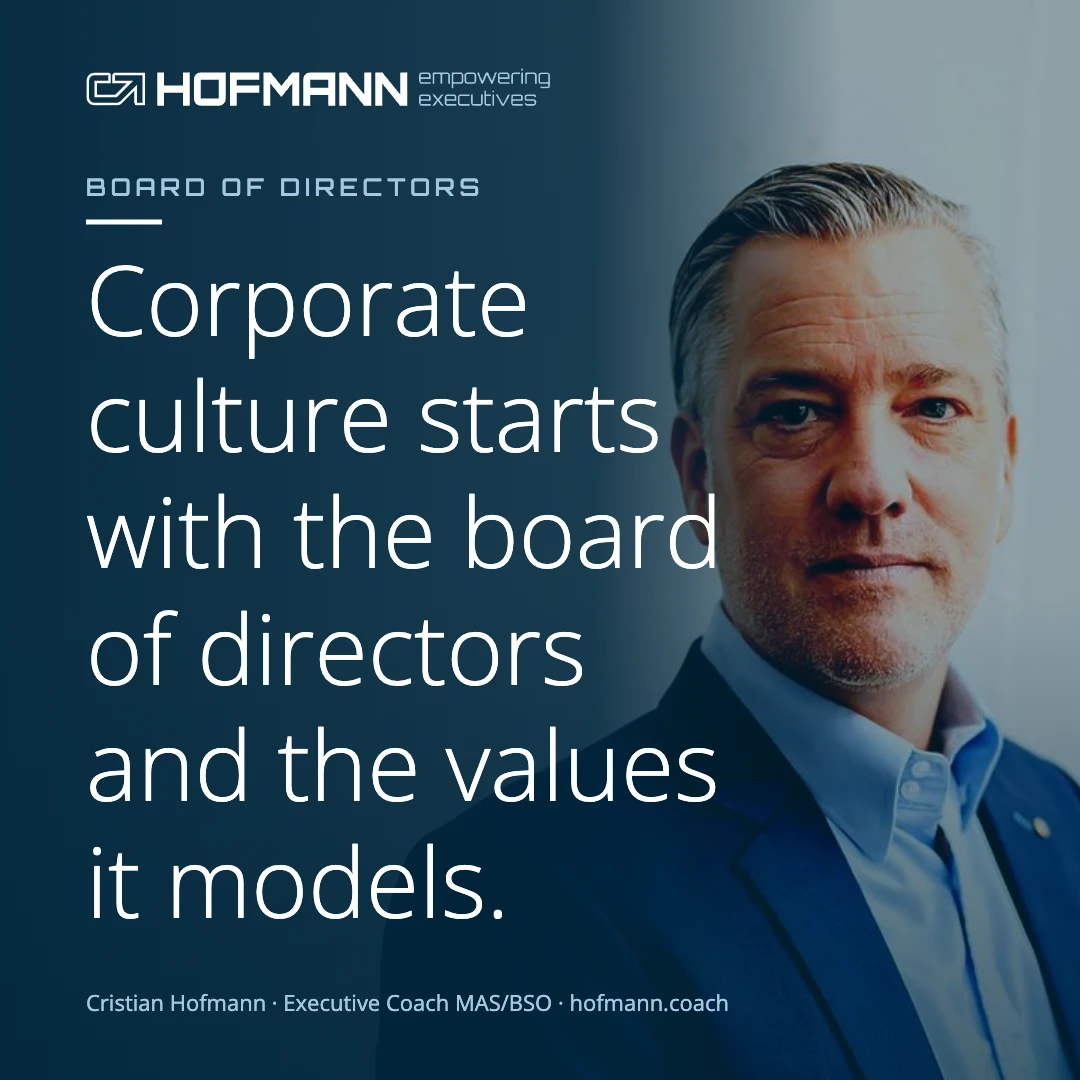
I take a critical view of the opposite extreme: A board that meddles in operations to control the culture. Closeness to the business means observing and modelling. Creating the culture in daily work is the job of executive management.
How I work with boards is described under Board excellence for the board of directors and the executive board.
It shapes culture from the top: Through the values it models, through its choice of executive management and through its own composition. In daily work, executive management has to do the shaping.
With employee surveys, impressions from site visits and direct conversations with employees. Resignations and signs of bullying complete the picture. The trend over several years tells you the most.
A structured self-review of the board: Composition, performance of the individual members and collaboration. It’s most useful when concrete measures follow from it.
Yes, especially when new members come from operational roles and the culture task is new to them. Coaching accompanies the self-reflection and translates insights into concrete steps, with goals agreed at the start.
Further reading on hofmann.coach: Business success: How much culture and leadership contribute · Top management team: How to make excellence visible · Stakeholder management: 13 ways CEOs keep everyone in the loop
Note: This article was first published on 26.06.2020 and was revised and expanded in October 2026.
Cristian Hofmann is an executive coach in Zurich and Schaffhausen (MAS Coaching & Supervision BSO, Forbes contributor). Over more than 20 years he has coached more than 1,500 leaders: CEOs, executive boards and leadership teams in Switzerland, with measurably agreed goals and, on request, pay-for-results. More about Cristian Hofmann.