You develop top leadership by sharpening your own judgement and, alongside your personal leadership, developing the leadership system of your organisation. At the top, the two work together.
Top leadership means leading at the highest level, in the executive team and on the board. This is where a company stays competitive or falls behind. And every behaviour at this level reaches far beyond your own team.
If you want to come across as credible there, with customers and with employees alike, you need concentrated expertise in the company’s most important problem areas. Good standing takes considerably more.
Effective leadership at the top secures competitiveness and good decisions. It includes a strategic perspective and the ability to lead change.
Emotional and social skills matter just as much as professional and leadership qualifications. So does a forward-looking commitment to the company.
Today, the people who live up to a role at the top bring credibility and integrity. Add communication skills, tolerance for stress and the capacity to carry a heavy load.
In the daily life of an executive board, this shows in small moments. How do you react when a colleague on the board criticises your project? And how do you deal with bad news that concerns you personally? Employees use moments like these to judge whether your integrity holds.
One of the abilities that counts most at the top is forming your own judgement in complex situations, independently of your colleagues.
Rarer still is the willingness to raise contentious topics. I mean holding a different view, or a flatly opposite one, in front of the leadership team or the management board.
This ability grows out of experience and expertise, out of trust in your own judgement, out of courage and emotional balance. You can develop it if you practise it deliberately.
Its worth lies in the timing. Boards often agree quickly, especially when the mood is good. Anyone who disagrees early, with reasons, forces everyone to check their assumptions before they get expensive. A counter-view of that kind is loyalty to the company, put into practice.
Models that used to hold work less and less, and new patterns of leadership and teamwork are only just emerging. These questions help you take stock. Pick one per quarter and discuss it in the executive board, with concrete observations from the last few weeks.
1. How do I develop my own management DNA so that it meets the new challenges?
2. How do we establish a leadership culture that promises confidence and success?
3. Which new thinking patterns help us find new approaches to solutions?
4. How does leadership shape the organisation’s process of change, and what influence does it have on its capacity to innovate?
5. What does our leadership culture contribute to the corporate brand? How you can influence culture as a leader is the subject of Corporate culture: What you can change as a leader.
6. How do we develop the leadership system as a whole, beyond the individual leaders? And how do we really anchor the principle of personal responsibility in the organisation?
If you engage with questions like these and look at your lived leadership practice with fresh eyes, your top leadership keeps developing. With it, the management DNA of the organisation develops as a leadership culture.
Investment in leadership at the top usually flows into individuals: Coaching for the CEO, a programme for the executive board. That makes sense, and it still falls short when the system stays the same.
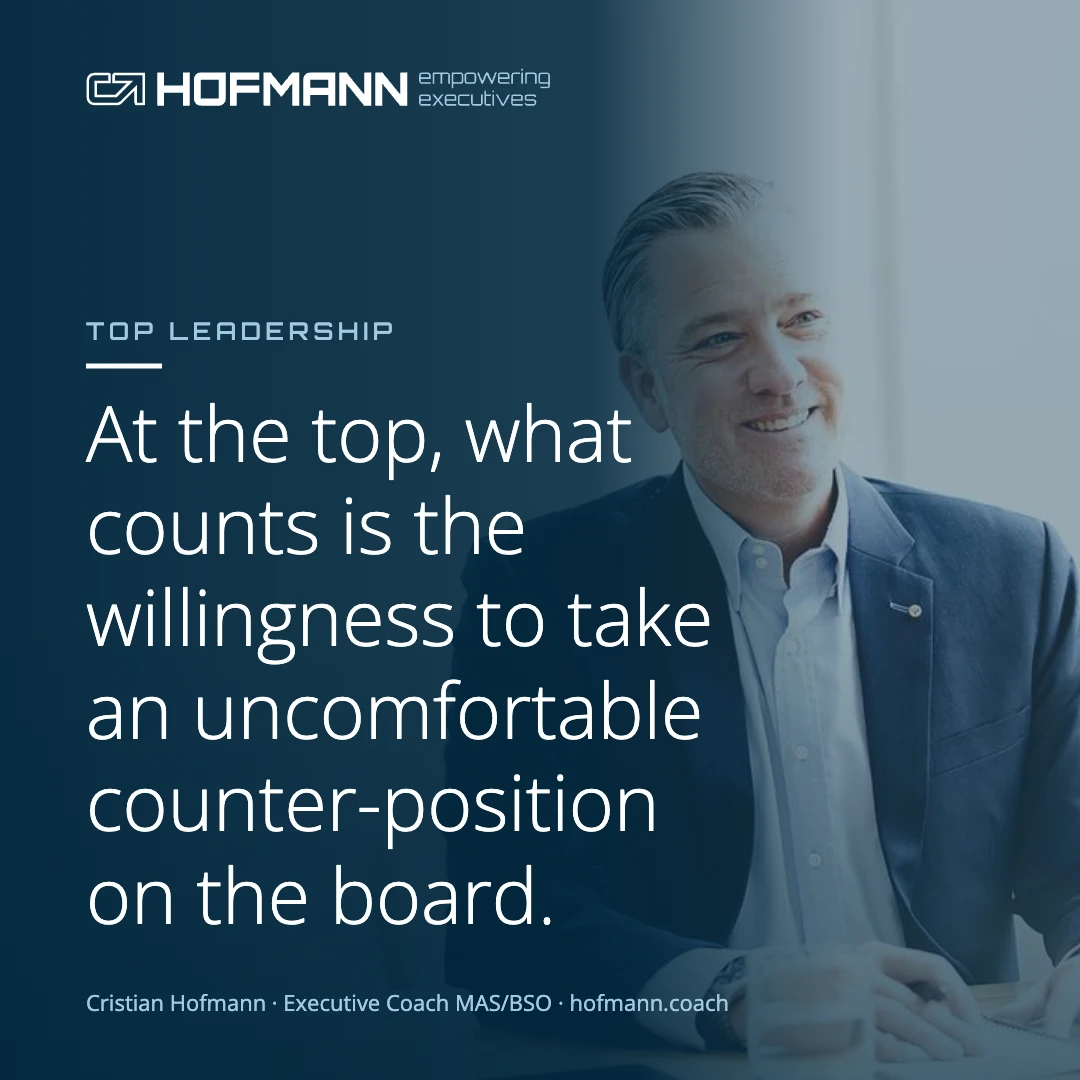
My position: Top leadership shows in the willingness to take an uncomfortable counter-position on the board. If nobody does, a board decides quickly, but rarely well.
I consider the opposite extreme just as risky: The permanent opponent who turns disagreement into a role. A counter-view needs substance and the shared goal in sight, or it becomes a ritual. So measure leadership at the top by behaviour that others can observe, for example with 360-degree feedback at the start and at the end of a development year.
Your own judgement in complex situations and the courage to stand by it on the board, even against the majority. Add credibility and integrity that customers and employees can feel.
Look beyond the individual leaders at the leadership system. Clarify which leadership culture you want and how personal responsibility gets anchored in daily work. The six questions above work well as a starting point for an executive board retreat.
Structured feedback helps, such as 360-degree feedback from the people around you. The Empowering Leadership Tool gives you a first indication, as a self-assessment of your leadership.
At the top, honest feedback gets rarer, because hardly anyone disagrees with you. An external coach brings that outside view. I agree measurable goals for this, with Pay-for-Results on request.
Further reading on hofmann.coach: Top executive: Raising impact and standing in the leadership team · Top management team: How to make excellence visible · Top management coaching: Why successful leaders work with a coach
Note: This article was first published on 22.08.2019 and was revised and expanded in October 2026.
Cristian Hofmann is an executive coach in Zurich and Schaffhausen (MAS Coaching & Supervision BSO, Forbes contributor). Over more than 20 years he has coached more than 1,500 leaders: CEOs, executive boards and leadership teams in Switzerland, with measurably agreed goals and, on request, pay-for-results. More about Cristian Hofmann.