As a leader, you change corporate culture mainly through how you behave every day: What you pay attention to, and how you react when something goes wrong. Culture plays out in each individual team, and that’s where a single leader has a surprising amount of influence.
For a long time, many companies focused on structures and processes. Today, corporate culture is seen as one of the most important factors in an organisation’s success. Fortunately, I’d say, because culture is the part every leader can help shape.
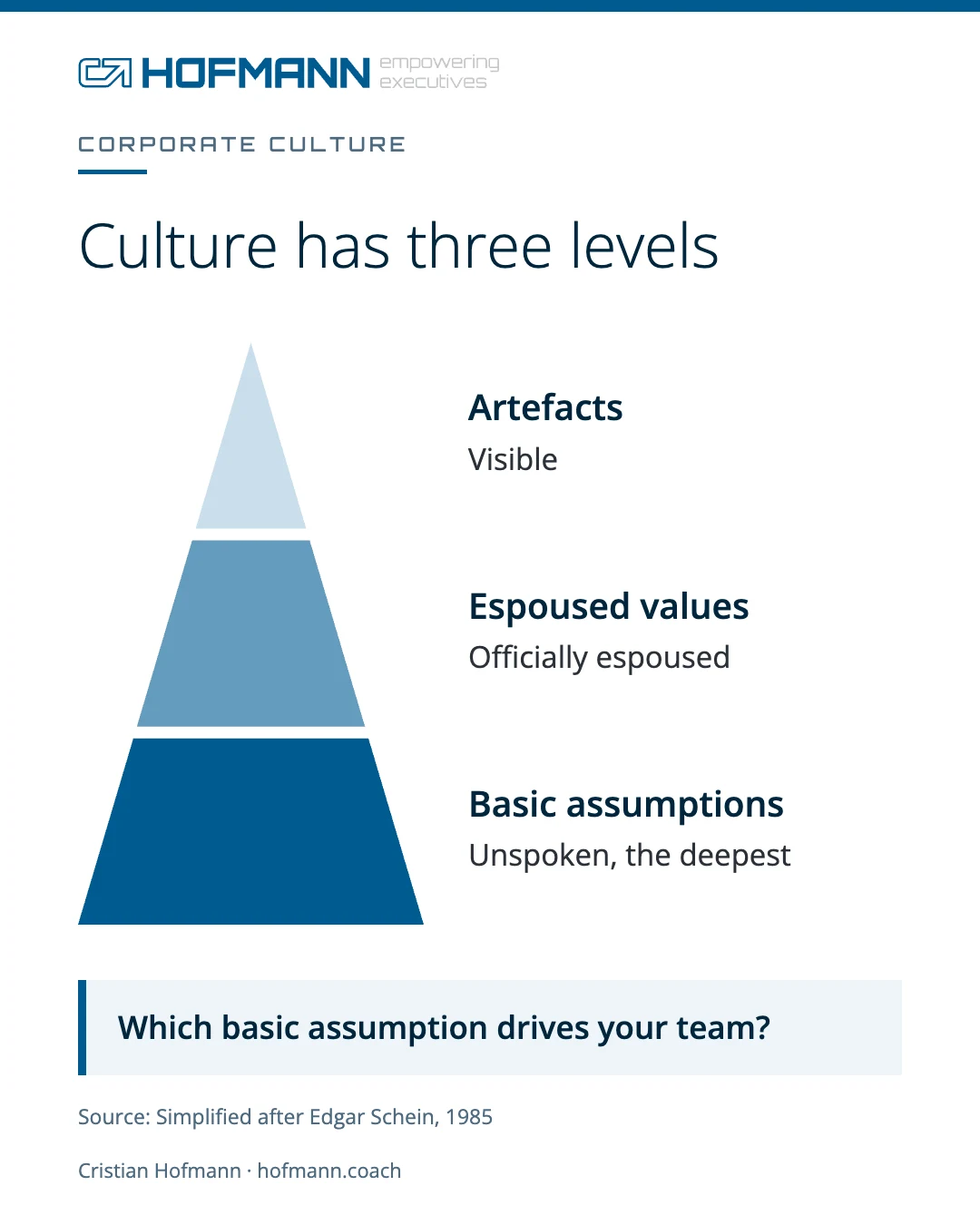
Corporate culture is the set of shared basic assumptions, values and norms that guide how people in an organisation act. In his 1985 book Organizational Culture and Leadership, the organisational psychologist Edgar Schein described it on three levels: Visible artefacts, the values an organisation officially espouses, and the unspoken basic assumptions underneath.
The third level runs deepest and is the hardest to pin down. Values and attitudes are difficult to set down in black and white. Every team member brings experience from earlier cultures and acts on it, which is exactly why letting go of the familiar is so hard.
The idea behind Schein’s work is that culture decides which strategy can be put into practice at all. Someone later boiled it down to the line “Culture eats strategy for breakfast”. It’s often attributed to Peter Drucker, although that attribution can’t be properly verified.
Edgar Schein also described how leaders pass culture on. Among the most important mechanisms, he lists what they pay attention to, how they react to crises, whom they reward and the behaviour they model themselves.
Your team remembers what you ask about. If you ask about the numbers first in every meeting and never about customers, you’re building a numbers culture, whatever the mission statement says. Start by asking what your customers actually got out of the work, and you’ll notice the team’s focus shift.
The way you handle mistakes sends just as clear a signal. Your first reaction to bad news decides whether you’ll hear the next piece of bad news in time. How you deal with conflict rubs off on the team as well (more on that in Conflict management: What leads to a constructive conflict culture).
Employees want to play an active part in shaping their company. For that, they need clearly defined room for manoeuvre and a leader who trusts first and checks later. People who are expected to work on their own need to know what the work is for.
When someone cares about the substance of their work and takes ownership, that deserves visible recognition. This is the point where independence in a team either grows or fades again.
Every healthy culture serves a purpose that reaches beyond revenue. You can translate your company’s purpose into one simple question for your team: What would be different for our customers if we didn’t exist?
Recognition means fair pay and, above all, respect in everyday work. If you acknowledge good performance visibly and let people grow with more demanding tasks, work becomes meaningful and their self-esteem rises. For what that looks like in day-to-day leadership, see Empowering leadership: What it means and how to put it into practice.
Your team always operates within a larger culture. If executive management preaches openness and punishes dissent, a single leader can cushion that, but rarely make up for it in the long run.
What helps then is talking openly with the level above you: Name the contradictions calmly and back them up with examples from your own area. When a company does internally what it says externally, that has more impact than any campaign.
Underneath it all sits a learning mindset: The ability to keep questioning yourself and adjusting. That goes for organisations and for every individual leader.
I think the culture in your own area is the most underrated lever a leader has. In coaching engagements, I often see leaders waiting for the next culture programme, while the answer is already sitting in their own Monday meeting.
My honest caveat is about patience. Culture changes through repeated behaviour, and that takes months, more likely years. You’ll only find out whether a change holds when you’re under pressure and still stick to your new behaviour.
A suggestion to get you started: For two weeks, write down what you ask about first in your meetings. The result shows quite precisely which culture you’re shaping right now, and it often comes as a surprise.
In your own area, yes, and noticeably so. Your team takes its cues from your questions and your reactions. Changing the culture of the whole company takes executive management. A unit that visibly works differently can make a strong case for it.
According to Edgar Schein, they’re visible artefacts such as spaces, rituals and processes, then the officially espoused values and, at the deepest level, the unspoken basic assumptions. Culture only changes for good once the basic assumptions start to move as well.
A team often notices the first changes in how people treat each other after a few weeks of consistent behaviour. Turning that into a new normal usually takes months.
Every leader for their own area, executive management for the company as a whole. HR can design processes that fit the culture you want. The modelling is down to the leaders themselves.
Further reading on hofmann.coach: Leadership lives in the minds of those you lead · Conflict management: What leads to a constructive conflict culture · Business success: How much culture and leadership contribute · Purposeful leadership: What really defines your leadership
Note: This article was first published on 11.01.2019 and was revised and expanded in October 2026.