A helpful leadership mindset and useful self-management help executives act more effectively when stress and pressure build up. Both can be learned. If you stay clear-headed under pressure, people in the company see you as more effective, and your reputation grows with it.
The video above is about a situation executives often describe to me in detail. Nothing is moving, time is running out, employees are complaining, and the project approval is still stuck with the management board. It keeps getting worse, and it feels like driving into a wall.
A leadership mindset is the basic attitude with which a leader interprets situations and responds to them. The psychologist Carol Dweck made the term mindset widely known with her 2006 book, in which she distinguishes a fixed from a growth mindset. People with a growth mindset see abilities as something they can develop and treat setbacks as a chance to learn.
Under pressure, one simple question helps: Do I read this situation as a threat I’m at the mercy of, or as a task I can shape? The situation stays the same. What you can do about it changes a great deal.
Three questions come first: How did it come to this? What can you do to deal with pressure? And what do useful self-management and a helpful leadership mindset look like?
On the first question: The wall is usually the sum of small delays that went unanswered for too long. Pressure builds gradually. A decision gets postponed, a team member complains, the next deadline moves closer, and at some point you’re only reacting.
Tunnel vision is typical at that stage. You mostly see what’s stuck and hardly notice what’s still in your own hands.
In 2013, the psychologist Alia Crum and colleagues studied how people’s beliefs about stress shape its effects. In their studies, participants who saw stress more as a resource reported fewer health complaints and better work performance.
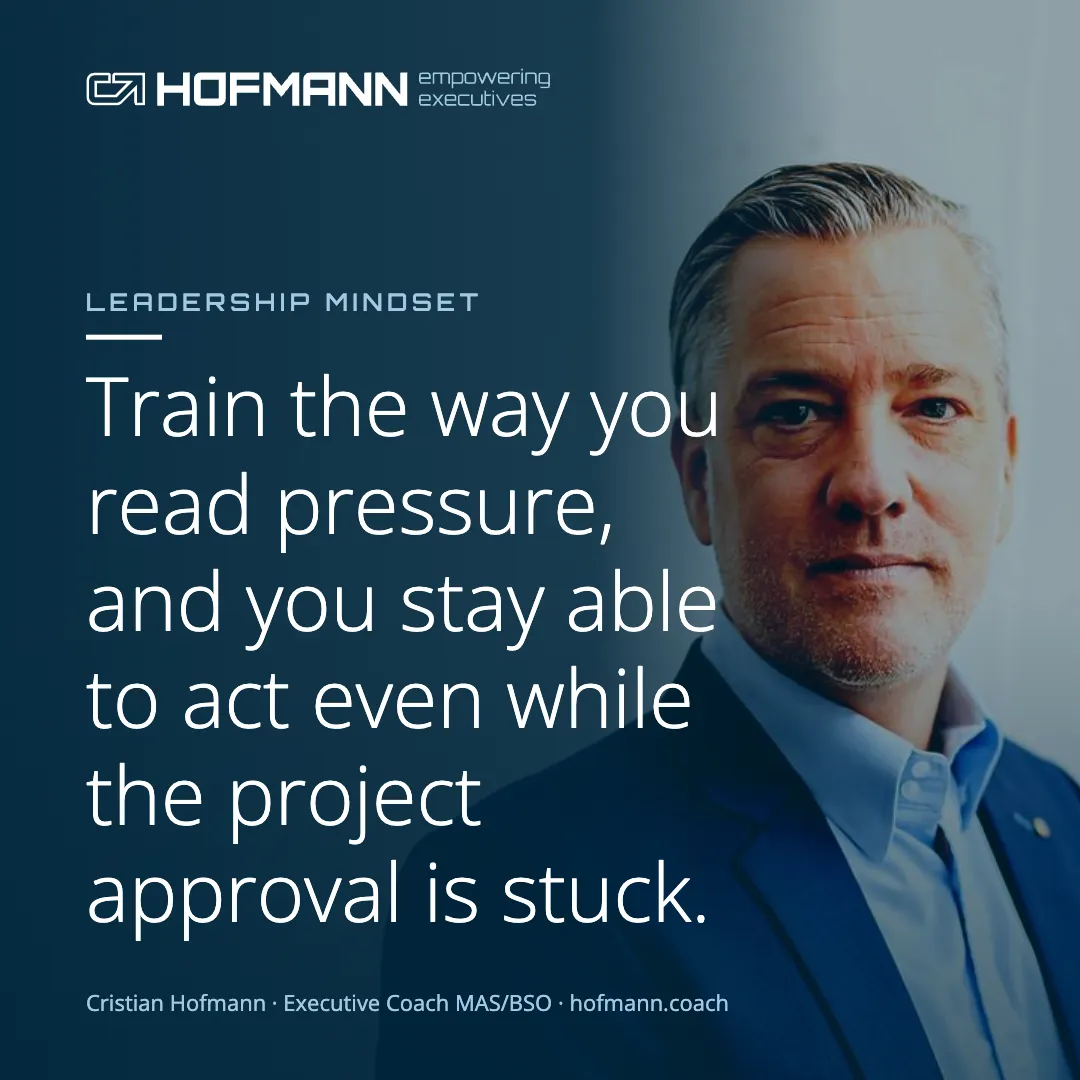
If you read pressure as a sign that something important is at stake, you have more room to act than someone who feels helpless. That reading can be practised like any other leadership skill.
Take an everyday example: The project approval is stuck with the board. One reading says “they’re blocking me”, another says “the board is evidently missing information I can provide”. Only the second leads straight to a next step.
Mindset and self-management work together. One shapes how you read the situation, the other what you actually do. Four levers help most in practice.
Clarify your sphere of influence: What’s down to me, and what’s down to the management board? With a stuck project approval, the decision lies with the board, and the conversation with the board lies with you. That distinction alone takes noticeable pressure off.
Reset priorities: Under pressure, everything feels urgent. A short list of the two or three tasks that really count today calms the mind.
Plan breaks: Short pauses between meetings are part of the work. If you rush from one appointment to the next, you’ll decide worse in the afternoon than in the morning.
Bring the team in: Discontent in a team often loses its edge once you address it openly. Sometimes the grumbling points to a problem leadership hasn’t spotted yet.
How to get back on your feet after a genuine mistake is the subject of 13 steps after a disastrous mistake at work. That article covers self-management in an acute emergency. This one is about the attitude you bring to sustained pressure.
Self-management and a helpful leadership mindset can be learned. In my work with executives, I often see how quickly things start moving once someone has a clear view of their own sphere of influence. Effectiveness goes up, and people start to see that person as an effective leader.
What helps most is knowing your own stress patterns. How do I notice that I’m slipping into the tunnel, and what reliably helps me then?
One doubt belongs here. Even the best attitude needs an organisation that works. If approvals are stuck for good and resources are missing, the problem belongs on the executive board’s table, and attitude alone won’t make it smaller.
It means the inner attitude with which a leader interprets difficult situations. That attitude helps decide whether someone sees room to act under pressure or feels at the mercy of events.
One is about how you interpret a situation, the other about what you actually do: priorities, breaks and how you handle your own calendar. Under pressure, you need both.
Yes, with practice. In tense moments, it helps to ask deliberately what lies in your own hands. Repeat that over a few weeks and you’ll respond to pressure noticeably more calmly.
The people around you watch closely how a leader reacts under pressure. If you prioritise calmly and communicate clearly, you give the team orientation. People remember that, often longer than a single project result.
Further reading on hofmann.coach: Team under pressure: How to help before it breaks · About Cristian Hofmann, executive coach · Leadership positioning: How to stand out clearly in a new role · C-level confidence: Between self-doubt and arrogance
Note: This article was first published on 05.07.2023 and was revised and expanded in October 2026.
Cristian Hofmann is an executive coach in Zurich and Schaffhausen (MAS Coaching & Supervision BSO, Forbes contributor). Over more than 20 years he has coached more than 1,500 leaders: CEOs, executive boards and leadership teams in Switzerland, with measurably agreed goals and, on request, pay-for-results. More about Cristian Hofmann.