C-level confidence is a top executive’s trust in their own judgement, especially when a decision affects the whole company. With too little of it, decisions get postponed and problems turn into burdens. With too much, it tips into arrogance. What you need is the right measure in between.
In a C-level role, you carry responsibility for the success or failure of the company. Leading at that level means knowing what you want, dealing with conflict and making tough calls for the good of the whole. That balancing act comes up regularly in executive coaching. So how well positioned are you?
Every leader needs self-confidence. At the top, though, the conditions change: The stakes of each decision rise, and the number of people who’ll openly disagree with you usually falls.
Then there’s exposure. The board, the executive team and the workforce all watch closely how a CEO or CFO handles uncertainty. Visible hesitation quickly reads as weakness there, and a rushed commitment as recklessness.
How self-confidence works for leaders in general is the subject of Self-confidence: The most powerful weapon of a leader. This article stays with what’s specific to the top level.
When you lack trust in your own abilities and your own worth, it shows first in how you decide. Decisions get pushed back as far as possible, or never made at all. Insecurity leads to the wrong reactions, often late ones.
Problems change character, too. What would be a solvable challenge becomes a real burden. At C-level that’s fatal, because a postponed decision travels through the whole organisation: Teams wait, projects stall and rumours fill the gap.
What top executives need in those moments is the courage to drive things forward. Add to that a strong inner drive that keeps you going even when the applause doesn’t come.
The line between confidence and arrogance is thin. Leaders with too much of it start believing that certain traits or habits are the reason for their success. So they hold on to them, even when those habits stopped helping long ago.
A typical sign is a skewed explanation: Successes go on your own account, failures on the circumstances. Social psychologists call this the self-serving bias. You can lead successfully like that for a while, rarely for long.
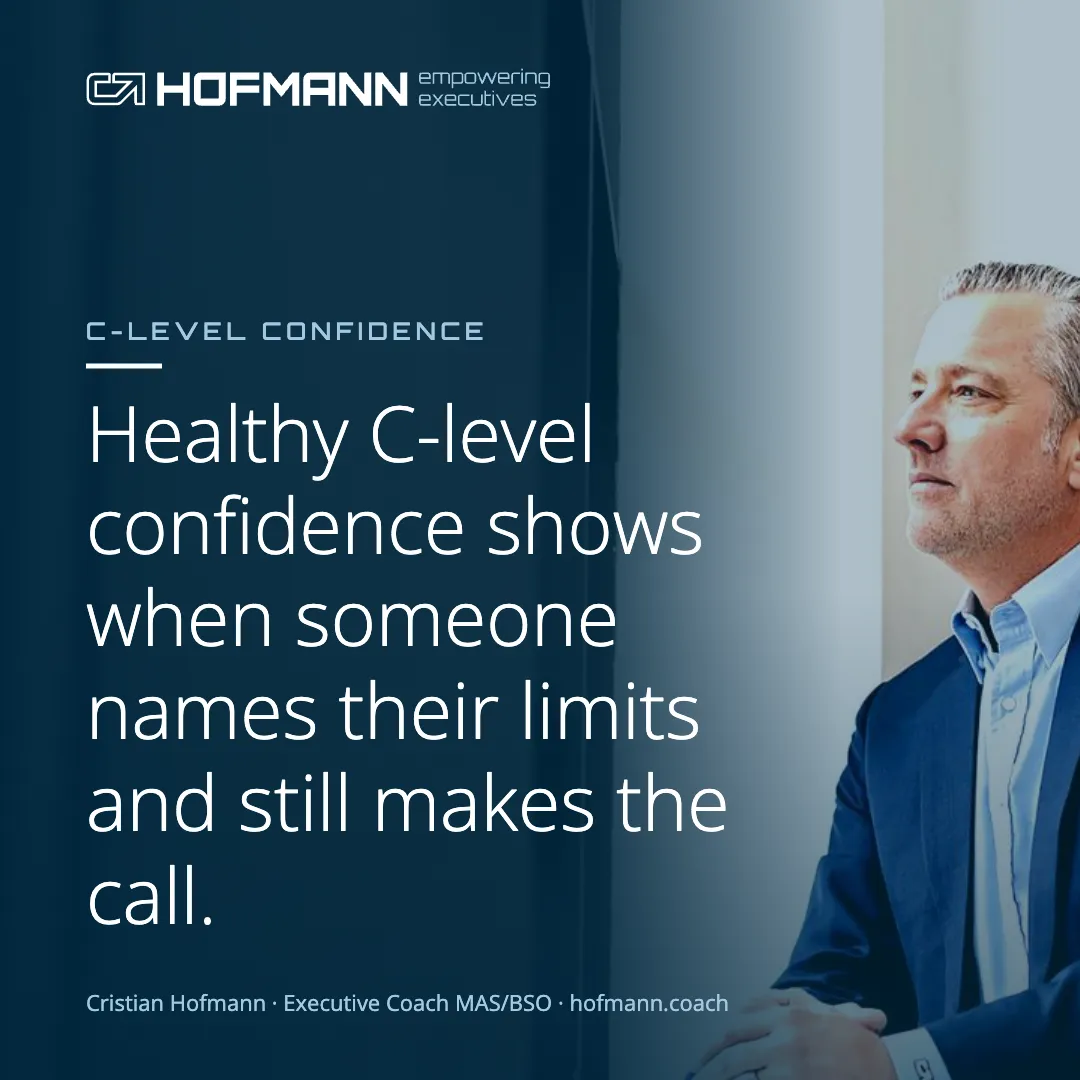
Healthy C-level confidence depends on a sober stocktake. Which abilities and talents really carry you, and where are your limits? What you’re after is a balanced attitude towards yourself, with honest self-reflection.
Self-awareness is a cornerstone of emotional intelligence. In his 1998 Harvard Business Review article “What Makes a Leader?”, Daniel Goleman described it as the first of five components that set outstanding leaders apart.
If you see yourself clearly, you also see the people around you, with their emotions and strengths. And you notice your own part in a situation. Reflective thinking and self-confidence feed each other.
Top executives with healthy confidence take calculated risks and stay open to change. Under pressure they react more calmly. Many think unconventionally, communicate clearly and have a correspondingly strong standing.
Working on yourself takes strength and energy. It pays off when you approach it in concrete terms.
Take stock: Get clear on your abilities, talents and limits. Ask for feedback from people who don’t depend on your goodwill.
Make successes visible: Look deliberately at what’s going well in your working day. At the top, it’s mostly problems that land on your desk, and that distorts the picture.
Practise deciding: Make smaller decisions faster and review them afterwards. Confidence grows with every decision whose consequences you’ve looked at honestly.
Look after yourself: Sleep and breaks sound trivial. In my experience, exhausted leaders doubt themselves sooner, and their judgement suffers.
For me, self-confidence is the fuel for the engine of excellence. I’ve helped many leaders raise their standing, and C-level confidence was often part of the work, spoken or unspoken.
My limit: Confidence grows through your own decisions. A coach creates the space for that and asks the uncomfortable questions, while the work itself stays with you.
And one honest doubt belongs here. A leader at the top who never doubts worries me more than one who admits doubt openly and decides anyway.
It’s a top executive’s trust in their own abilities and judgement under the conditions of the top level. Those include decisions with far-reaching consequences, high visibility and little honest pushback.
Most clearly from postponed decisions. Add hectic or late reactions and the feeling that every problem is a weight. The people around you often notice before you do.
It runs where someone credits successes only to themselves and blames failures only on circumstances. If you can name your own limits, you’re usually on the healthy side.
Yes, through work on yourself that takes energy. Honest feedback helps, and so do a deliberate look at your successes and decisions you review afterwards. In executive coaching, I agree measurable goals for this, with Pay-for-Results on request.
Further reading on hofmann.coach: Top management coaching: Why successful leaders work with a coach · About Cristian Hofmann, executive coach · Leadership positioning: How to stand out clearly in a new role · Leadership mindset: Staying effective when the pressure rises
Note: This article was first published on 05.07.2023 and was revised and expanded in October 2026.
Cristian Hofmann is an executive coach in Zurich and Schaffhausen (MAS Coaching & Supervision BSO, Forbes contributor). Over more than 20 years he has coached more than 1,500 leaders: CEOs, executive boards and leadership teams in Switzerland, with measurably agreed goals and, on request, pay-for-results. More about Cristian Hofmann.