Change management decides whether a transformation programme reaches its goals or runs out of steam halfway. The video above shows a typical moment: In a meeting, a management team realises that the pressure to deliver the current programme is rising. At the same time, nobody wants to invest more money or time.
This is the most delicate point of any change. The energy of the launch is used up, the results are not yet visible. Here it shows whether a team leads or merely administers.
The data is clear. Projects with excellent change management are six times more likely to meet their objectives than projects with poor change management (Prosci, Best Practices in Change Management research). Yet that is often exactly where companies cut first when budget and patience run short.
Change management is the guided transition of an organisation from its current state to the desired one. It connects two sides: The organisational side with target picture, plans and processes, and the human side with understanding, resistance, energy and trust.
Most change projects I see stall had good plans. They tipped on the human side: Leaders who told the target picture in different ways, and resistance that nobody took seriously.
Poorly led change projects have consequences every executive board knows:
Productivity drops. People talk about the change during breaks and stay silent in meetings.
Camps form. Employees put up passive resistance or split into supporters and opponents.
Budget and schedule slip. Money invested is lost, and the next attempt starts with less trust.
Good people leave. Often the very people the new organisation would need most.
In a client project we built a change management culture together that carries beyond the single programme. It rested on a framework of change methods, tools and processes. The framework answers four questions before the first slide exists:
Where to? A target picture that can be explained in two sentences.
Why now? A reason employees can believe.
Who leads? Named people who own the change in their area.
How do we see progress? A few measures the leadership team reviews every month.
The framework is the scaffolding. Without it, every change turns into improvisation, and in large organisations improvisation quickly costs months.
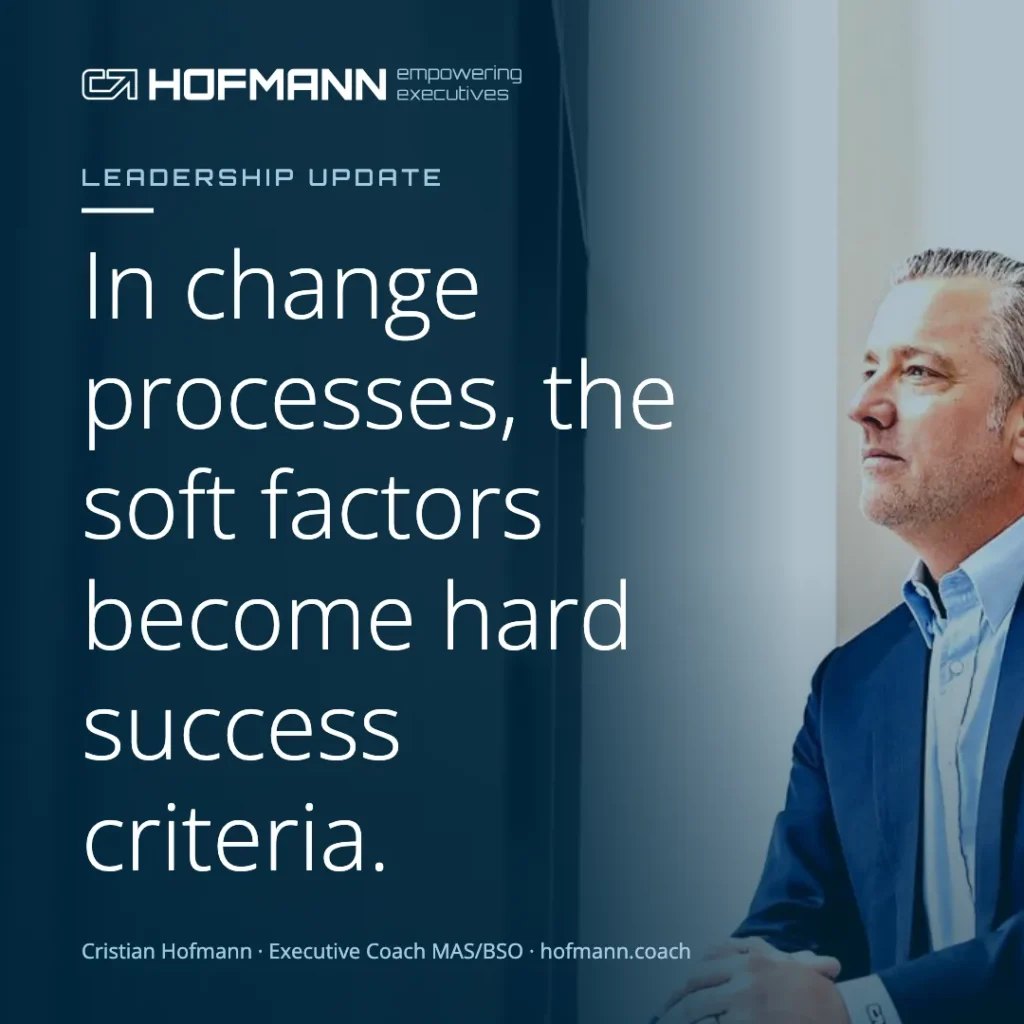
Leadership matters even more than structure. That is why we trained change leaders: Leaders who understand both the human and the organisational side of change. In change processes, the soft, emotional factors become hard success criteria. Anyone who overlooks that measures progress in milestones and wonders about the mood.
Change leaders sit in the line, usually one level below the executive board. They translate the target picture into the daily work of their area. In my experience, you recognise good change leaders by four habits:
They address resistance. Resistance is information. Hear it early, and the plan can still be adjusted cheaply.
They tell the same story. Five leaders with five versions of the target picture create five different projects.
They hold uncertainty. Change raises open questions, and change leaders resist covering them with hasty promises.
They make small progress visible. Early wins give the team a reason to keep going.
Good change management clearly raises the chance of reaching project goals.
A lack of structure leads to resistance, camps and lost budgets.
A clear framework of methods, tools and processes gives orientation.
Success depends on change leaders who take the emotional side of change seriously.
Mostly because of the assumption that a good plan implements itself. An organisation needs leadership that explains, listens and takes resistance seriously. Without it, camps form and the budget flows into rework.
Small adjustments within one team hardly. As soon as roles, processes or collaboration change for several teams, yes. The more people have to change their behaviour, the more leadership the change needs.
A leader, usually in the line, who translates the target picture of a change into their own area and leads its human side. Change leaders learn to use resistance, communicate clearly and tolerate uncertainty.
With a few measures agreed before the start: Achievement of project goals, acceptance among those affected (for example via a short survey), speed of implementation and staff turnover in the affected teams. The trend over several months says more than any single reading.
Executive coaching supports the people who lead the change: The executive board and the change leaders. It works where plans meet people, on attitude, communication and handling pressure.
I am glad to look with you at how to set up change management more effectively in your organisation. As an executive coach I work with top managers and leadership teams as a sparring partner, with measurably agreed goals. More on my approach under Change Leadership.
Further reading on hofmann.coach: Crisis leadership: How leadership teams lead out of a crisis · Conflict management: What leads to a constructive conflict culture · Leadership Coaching · Stakeholder management: 13 ways CEOs keep everyone in the loop
Source of the figure: Prosci, Best Practices in Change Management research. The original article dates from January 2020, the text was revised in October 2026.
Cristian Hofmann is an executive coach in Zurich and Schaffhausen (MAS Coaching & Supervision BSO, Forbes contributor). Over more than 20 years he has coached more than 1,500 leaders: CEOs, executive boards and leadership teams in Switzerland, with measurably agreed goals and, on request, pay-for-results. More about Cristian Hofmann.