Employee strengths come into their own when leaders create an environment with self-esteem, room to act, orientation, solid relationships and enjoyment at work. In that kind of environment, people take ownership of their roles, and satisfaction and productivity go up. That’s the core of empowerment.
In leadership, empowerment means enabling employees to shape their work with their own competence and their own room for decisions. I described the basic idea in 2023 in an article for Forbes Coaches Council. This version is revised and expanded with what I’ve seen in coaching engagements since.
I describe leadership excellence as the ability to recognise potential and to create a climate in which people feel supported and can act on their own. Put individual strengths and behaviours at the centre, and you lay the ground for a culture where collaboration and performance go together.
One key is self-management. Employees need a clear picture of themselves and an understanding of why collaboration matters. Leaders can encourage both: With clear communication, guidance and the resources people need.
Take the time to really get to know each team member. Trust and open dialogue grow out of that, and motivation grows out of both.
One approach I work with is the SCOAP model. It names five elements leaders can nurture in their people so that well-being and engagement grow.
Self-esteem: The confidence and self-worth employees have in themselves and their abilities.
Control: How much autonomy people feel over their work, their environment and their decisions.
Orientation: The fit between employees’ personal goals and values and those of the organisation.
Attachment: The quality of relationships with colleagues, with their manager and with the organisation as a whole.
Pleasure: Positive emotions and enjoyment at work.
In practice, the five elements interlock. Lots of control without orientation leaves people scattered. And someone who is well connected but has no room to act tends to settle in comfortably.
For the team: Leaders who understand and live the organisation’s values build trust and respect. They make sure people meet regularly in person, including across departments that otherwise have little to do with each other. An open culture of discussion ties people to shared initiatives and makes conflicts easier to solve.
For the organisation: Teams with leaders like this spot opportunities faster and find their own ways to use them. Customer satisfaction and productivity are likely to rise as a result.
For the leader: The more a leader sees it as their job to make sure employees find their work meaningful, the greater, in my observation, their own resilience. Setbacks become easier to handle.
Make meaning and purpose clear. People want to understand what their work achieves. Help them connect their own goals with the company’s, ask for their input and feedback, and give them chances to contribute visibly to the mission.
Build relationships. Respect and inclusion help teams work well together. That includes open communication and chances to meet outside day-to-day business.
Recognise achievements. Recognition is a central part of job satisfaction. It shows in regular feedback and in real opportunities to develop.
In the end, people have to see what they’ve achieved through their own effort. Good leadership makes that link visible.
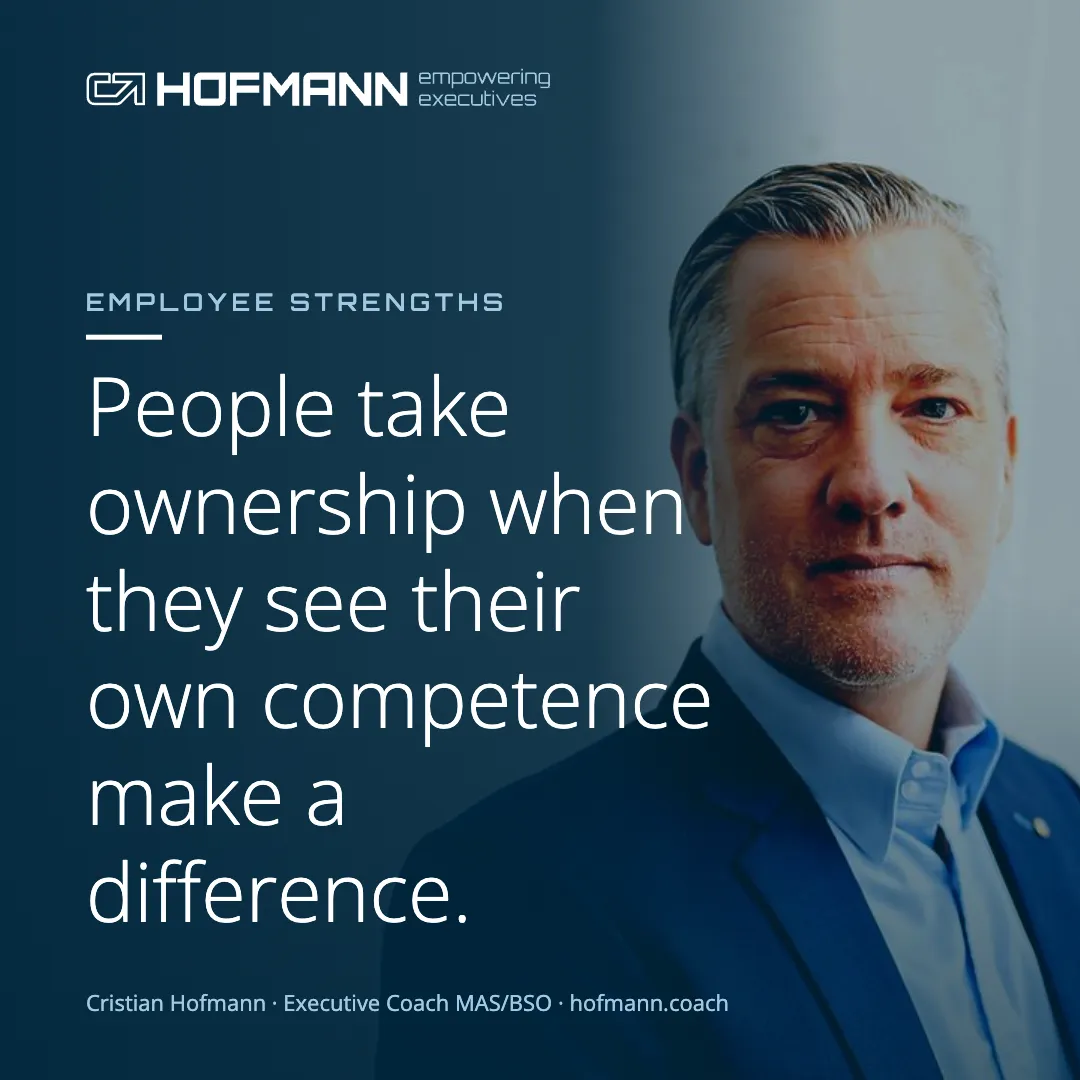
Employees’ motivation depends heavily on whether they can influence situations successfully through their own competence. The psychologist Albert Bandura described this in 1977 as self-efficacy.
When everyone can take ownership of their role, you get a team that holds together and succeeds. Leadership excellence makes these contributions visible: It helps individuals define their own growth goals and shows what they add to the success of the team and the organisation.
With clear communication and recognition, you build a culture in which employee strengths carry results over time.
I consider a focus on employee strengths the most direct route to empowerment. In coaching engagements, I often meet leaders who know the five elements intuitively and still nurture only one or two of them consciously, usually the ones closest to their own preferences.
There’s a limit, though. Many people experience empowerment without clear goals and guardrails as being left alone. And some work simply has to get done, even if it doesn’t suit anyone on the team particularly well.
What this looks like day to day is the subject of Empowering Leadership: What It Means and How to Embrace It. For leaders’ own self-assessment, I use the Empowering Leadership Tool. It shows where action is needed and which competencies are already well developed.
Through observation and conversation: What is someone good at, and what gives them energy while they do it? Ask directly about tasks where time flies. Structured feedback within the team completes the picture.
Empowerment means giving employees room to act and the resources they need to shape their work independently. The leader sets goals and the frame and leaves most of the route to the team.
First check whether tasks can be distributed differently within the team. Often a role can be shaped so that employee strengths come through more clearly. Where that isn’t possible, you need clarity about the must-do work and recognition for getting it done.
Further reading on hofmann.coach: Employee incentives: 14 ways to motivate people in large companies · Leader as coach: How leaders build trust · About Cristian Hofmann, executive coach · Strengths-based leadership: 15 ideas that go beyond your strengths
Note: This article goes back to my article “Leadership Excellence: Empowerment By Maximizing Employees’ Strengths” in the Forbes Coaches Council from 30 March 2023 and was revised and expanded in October 2026.
Cristian Hofmann is an executive coach in Zurich and Schaffhausen (MAS Coaching & Supervision BSO, Forbes contributor). Over more than 20 years he has coached more than 1,500 leaders: CEOs, executive boards and leadership teams in Switzerland, with measurably agreed goals and, on request, pay-for-results. More about Cristian Hofmann.