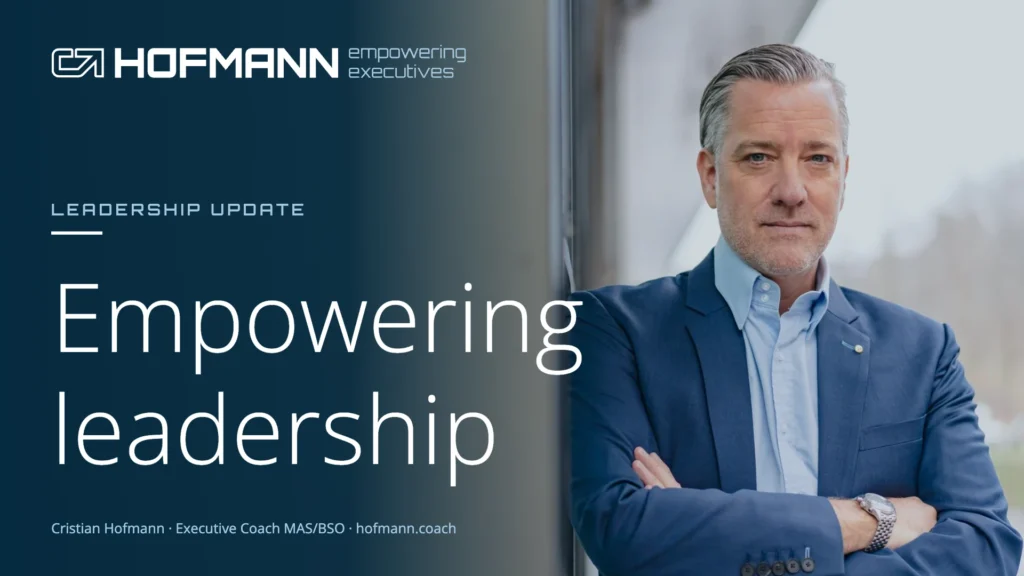
Empowering leadership is a leadership style in which you move decisions to where the knowledge sits: with the people who do the work. You set the goal and the boundaries, and your team decides how to get there. The result is people who take ownership of their work and solve problems before they land on your desk.
In my coaching work I usually meet the topic from the other side. Leaders want to hand over more and still pull decisions back to themselves. What is usually missing are clear guardrails, and without them letting go feels like losing control.
Empowering leadership describes leadership that gives people decision rights and trust, and room to grow in their roles. The leader stays accountable for the goal and the result. The how belongs to the team.
In 1995 the organisational psychologist Gretchen Spreitzer described when people feel empowered at work. Four experiences come together: The task feels meaningful, people feel competent to do it, they can choose how to approach it, and they see that their contribution has an impact.
If one of them is missing, delegation stays a formality. Someone who may decide but never learns what became of the decision soon loses interest.
For leaders this means: Delegating is the first step. Empowerment only becomes tangible when all four experiences are in place.
A few signals come up again and again in leadership teams:
Upward delegation. Tasks come back to your desk with the question of how exactly they should be done.
Permission requests. People ask for sign-off on decisions they could easily make themselves.
Silence in meetings. Almost all proposals come from the leader while the team waits.
A full diary at the top, waiting below. The leader works at the limit while projects wait for decisions.
Behind these signals there is usually a lack of clarity about goals and room to act.
1. Make the goal and the boundaries clear. Say what needs to be achieved by when and within which limits. The clearer the frame, the more freedom you can allow inside it.
2. Hand over decision rights explicitly. Name the decisions that belong to the team from today. If you hand over tasks and keep the decisions, you will get questions back.
3. Provide the resources. Information, budget, time and access to the right people all belong here. Without them, ownership becomes a burden.
4. Recognise results visibly. Recognition shows people that their own decisions make a difference. Say specifically what went well and why.
5. Make learning possible, including from mistakes. Anyone who takes ownership will sometimes decide wrongly. How you react determines whether anyone will have the courage next time. My article on steps after a serious mistake at work goes into this.
Teams with clear decision rights react faster because not every question has to travel through the hierarchy. The leader gains time for the topics that genuinely belong at their level: strategy, stakeholders and developing their people. And people who make their own decisions tend to stand behind the result more firmly.
The approach tips over when freedom arrives without orientation. People then experience freedom as being left alone, especially in new roles or under heavy pressure.
I describe the basic needs behind this in my article on employee strengths: self-esteem, control, orientation, attachment and enjoyment of the work. If one of them is missing, even generous room to act only works halfway.
Empowering leadership starts with the leader. Most of the people I work with know exactly what they should do. The hard part is tolerating it: The team decides differently from how you would have decided, and the result is still good.
My recommendation: Hand decisions over earlier than feels comfortable and agree clear checkpoints for them. Control then moves away from the details and into the rhythm of your conversations.
One simple question helps before you pull the next decision back to yourself: Do I need to decide this, or does someone in the team know more about it than I do?
I see one limit in acute crises. When things have to move fast and the situation is unclear, teams first need direction. Empowerment comes back in a second step, and leaders should say so openly.
Delegation hands over a task. Empowering leadership also hands over the decisions that belong to the task and creates an environment in which people are willing to make them.
In experienced teams it usually works very well. New team members or a crisis call for more guidance first and a narrow frame that widens as experience grows.
Pick one decision you currently make yourself and hand it over explicitly to a person or the team. Agree straight away when you will review it together. That way trust grows on both sides.
By fewer queries, faster decisions and proposals that come from the team. In my mandates I agree measurable goals at the start so the change becomes visible.
Further reading on hofmann.coach: Strengths-based leadership: 15 ideas that go beyond your strengths · Leader as coach: How trust and standing grow in your team · Team collaboration: How individuals become a leadership team
Note: This article was first published on 12.06.2024 and was revised and expanded in October 2026.
Cristian Hofmann is an executive coach in Zurich and Schaffhausen (MAS Coaching & Supervision BSO, Forbes contributor). Over more than 20 years he has coached more than 1,500 leaders: CEOs, executive boards and leadership teams in Switzerland, with measurably agreed goals and, on request, pay-for-results. More about Cristian Hofmann.