
Positive leadership is an investment in leadership culture, and like any investment it deserves due diligence.
Positive leadership rests on the foundation of positive psychology. The approach directs a leader’s attention to what works: the strengths of employees, successful collaboration, meaning in work, recognition for concrete performance. The basic idea is simple. People who feel seen and can use their strengths perform better and stay longer. There is evidence for this, and I dispute none of it.
What I do dispute is the way the approach is introduced in many companies. As a measure within leadership development, with a budget, a timeline and a kick-off. As if leadership culture were a project with an end date. Anyone who proceeds this way confuses an attitude with a method. The method can be bought. The attitude can only be developed, and it has to be developed in every single leader.
Most texts on positive leadership tell the success story. See strengths, unlock potential. What is rarely told: Where the introduction creates friction. There are five such points. Mindset, timing, time horizon, sustainability, habituation. Five terms, behind each of which stands a decision that no programme can take off your hands.
These friction points appear in every organisation that wants to move strengths orientation from the slide deck into everyday work, regardless of industry or size. I encounter them in executive coaching with members of executive boards as much as in work with leadership teams, in Zurich, in Schaffhausen, across Switzerland and the German-speaking region. That the approach also has a dark side when it becomes a compulsory exercise is something I described in my article on the dark sides of positive leadership. This piece is about the question that comes before: Whether and when an organisation should invest at all. What follows is my reading.
Positive leadership presupposes a view of human nature. Anyone who believes that people work better under pressure than under recognition will never lead this approach authentically. They will administer it. Attitude can be developed, but only if the leader wants it.
The qualifier is the decisive part. If the leader wants it. In practice, positive leadership is frequently decreed. The executive board decides, HR rolls out, line management completes the process. The result: Leaders who hold strengths conversations because they are in the process. Employees notice the difference within seconds. Being praised by someone who does not mean it costs more trust than no praise at all.
The test question is therefore: Do our leaders believe in the view of human nature behind this? Anyone who answers no needs an honest conversation about whether they want to lead in this culture. A training course changes nothing about that. What can change something is work on one’s own attitude, in leadership coaching, in reflection with peers at the same level, in confronting one’s own understanding of leadership. That takes longer than two training days, and it cannot be delegated.
Investors know that the right asset at the wrong time loses money. The same applies to positive leadership. The right moment is hard to hit. The wrong one is easy to recognise, if you look.
Talking about strengths in the middle of a restructuring comes across as cynical. Making wellbeing the leadership topic after a lost major contract looks like a diversion. The message does not land because the organisation is asking a different question at that moment: Am I safe?
Times of crisis can still be the right moment, provided the introduction names the crisis instead of papering over it. A leader who says «We are under pressure, and that is exactly why I am now looking at what works» will be heard. One who acts as if nothing were happening loses credibility with the first sentence.
For the executive team this means: Timing is a change management question. What question is the organisation asking right now? Safety, orientation, meaning? Positive leadership answers the third. Anyone who leaves the first two open is talking past their people.
What is called a bubble in the investment world is often called an initiative in leadership culture. Too much expectation in too short a time, and the approach is burnt out before it can carry weight.
This is the most common pattern. The organisation introduces the approach and expects measurable culture change after one quarter. After two quarters the CFO asks about the return. After three quarters the topic is quietly written off and the next initiative is waiting. Employees have learned: This too shall pass.
The test question is precise: By what, and by when, will we recognise that we have succeeded? Anyone who leaves this question unanswered before the start should not start. And the answer must not be exhausted by «employee satisfaction plus three points». It has to describe behaviour. What will leaders do differently in six months that nobody does today?
A usable yardstick is observable leadership routines. How does the one-to-one begin? What does the team meeting end with? How does the executive board talk about employees when they are not in the room? These things can be compared after six and after twelve months, without a survey and without consultants.
There are investments that pay out a lot once, and those that keep paying. Positive leadership belongs to the second kind. It works like compound interest: Small, regular deposits whose effect builds up over years. An interested question. Specific praise at the right moment.
The lump sum, by contrast, is often counterproductive. The kick-off with an external keynote speaker, the glossy booklet. They create expectations that everyday life does not fulfil. The gap between the staging and Monday morning is the space in which cynicism grows. And once the trust account is empty, even the largest special payment saves nothing.
Positive leadership becomes sustainable through leaders who change their routines. The one-to-one that opens with the question of what went well. The meeting that closes with a specific thank-you instead of a general one. This is unspectacular. That is why it is underestimated. That is why it works.
Leadership culture arises from exactly these repetitions. It can be shaped from the top, but only through what senior leaders do every day, and hardly at all through what they announce. Leadership happens in the perception of the people being led, which I explore in Leadership lives in the minds of those you lead.
The most important open question about the approach is the one asked least often: Do recognition and positive attention lose their effect through habituation?
I have no conclusive answer to this, and I am not sure the research has one yet. What I see in practice are two patterns that point in the same direction, and both of them concern me.
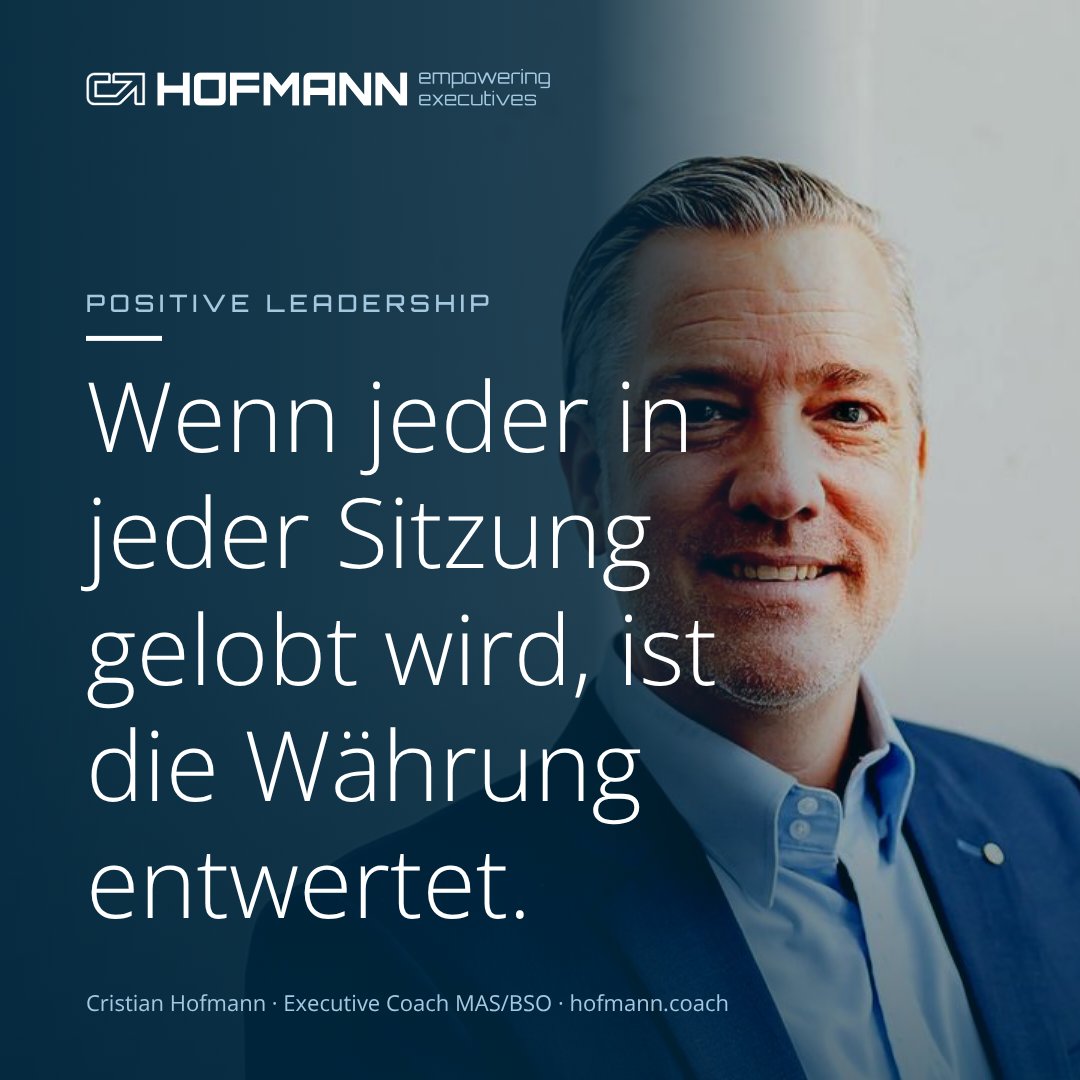
Praise that becomes a formula is subject to inflation. If everyone is praised in every meeting, the currency is devalued. Recognition works because it is specific and because it is not guaranteed. Both are lost in routine.
The second pattern is more subtle. Organisations that consistently look at strengths sometimes develop a reluctance to name weaknesses. The culture becomes friendly and blurred. Criticism is seen as a violation of the approach. This is a misunderstanding of positive leadership, but an obvious one. Those who see strengths are allowed to name weaknesses; both belong to the same attitude. The best prevention against habituation is the ability to be tough, even in a positive culture, when the matter demands it. I have written about this balance in How leaders can do more than play to their strengths.
Anyone who introduces positive leadership will sooner or later be asked what it has achieved. Qualitative feedback from all levels of the hierarchy is one answer. Business metrics are the other. Both belong on the table, as a discipline for oneself, before third parties ask.
An approach that claims impact must show it. The question «By what will we recognise success?» from Test 3 obliges you to look honestly after twelve months, even if the result is uncomfortable. The same principle applies to every form of leadership development and to executive coaching: Impact that nobody perceives except the coach and the coachee is not impact. How leadership impact can be made visible and measurable for the people around a leader is the subject of my article Making effective leadership tangible.
Positive leadership is an attitude you either have or develop, and a behaviour you either repeat daily or do not. Both start in the executive team. A leadership team that decides on strengths orientation for line management and does not practise it in its own meetings sends the real message: This applies to you, not to us. The organisation hears the second half.
The executive team therefore has three tasks that no programme takes over. First, clarify its own attitude, individually and as a body. Second, define the expectations regarding time horizon and evidence before the start, in writing. Third, change its own routines first, before line management is asked to. Anyone who takes this seriously will find that positive leadership is less an HR topic than a question of personal leadership development at C-level. This is exactly where leadership coaching comes in: At the attitude of the individual leader and at what their environment perceives of it.
The five tests translate into five questions:
A leadership approach based on positive psychology. Leaders deliberately direct their attention to strengths, successful collaboration, meaning and recognition in order to foster engagement and performance. The term was popularised by the American organisational scholar Kim Cameron.
The two belong together but are not identical. Positive leadership focuses on strengths and success. A constructive error culture ensures that weaknesses and mistakes may be named. Without the second, the first degenerates into friendliness without substance.
Behavioural changes in leaders become perceptible to those around them after six to twelve months, provided they are repeated consistently. Culture change at organisational level takes years. Anyone expecting metrics after one quarter has chosen the wrong yardstick.
Positive leadership stands or falls with the attitude of the individual leader. Executive coaching works exactly there: On the view of human nature, on daily routines and on the question of what the environment actually perceives of the change. A training course conveys the method. Coaching develops the attitude.
Cristian Hofmann is an executive coach in Zurich and Schaffhausen (MAS Coaching & Supervision BSO, Forbes Coaches Council). Over more than 20 years he has worked with over 1,500 leaders: CEOs, executive committees and leadership teams across Switzerland, with measurably agreed goals and, on request, Pay-for-Results. Learn more about Cristian Hofmann
In person in Schaffhausen, Zurich, St. Gallen and Basel
Executive Coaching · Leadership Development · Empowering Executives
First published as a LinkedIn article on 11 October 2026. All observations come from the author’s coaching practice and are anonymised.

This website uses cookies to ensure you get the best experience on our website. Learn more