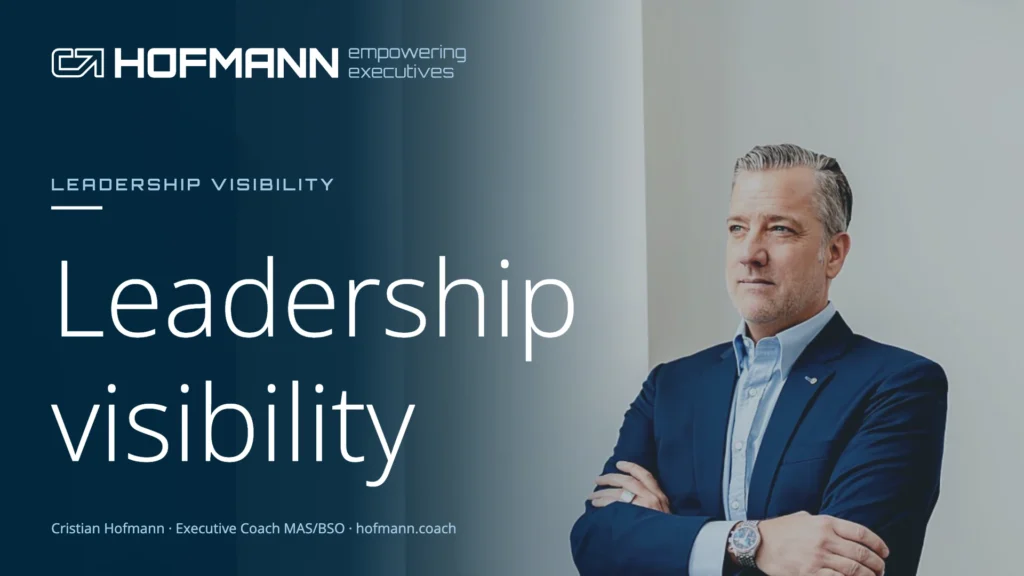
Leadership visibility develops when the people around you connect your results with you as a person. That takes two things: A solid relationship with your team and a clear position on what you stand for in the organisation. Self-promotion alone rarely gets you there.
Some leaders are simply successful. Simply? From the outside it looks that way when the relationship between boss and team works. Hardly anyone notices the effort behind it, and success rarely comes on its own.
Back in 2018 I saw the core in emotional intelligence, and that hasn’t changed. The psychologist Daniel Goleman made the term widely known in 1995 with his book “Emotional Intelligence”. In his 1998 Harvard Business Review article “What Makes a Leader?”, he describes five components, including self-awareness and empathy. The other three are self-regulation, motivation and social skill.
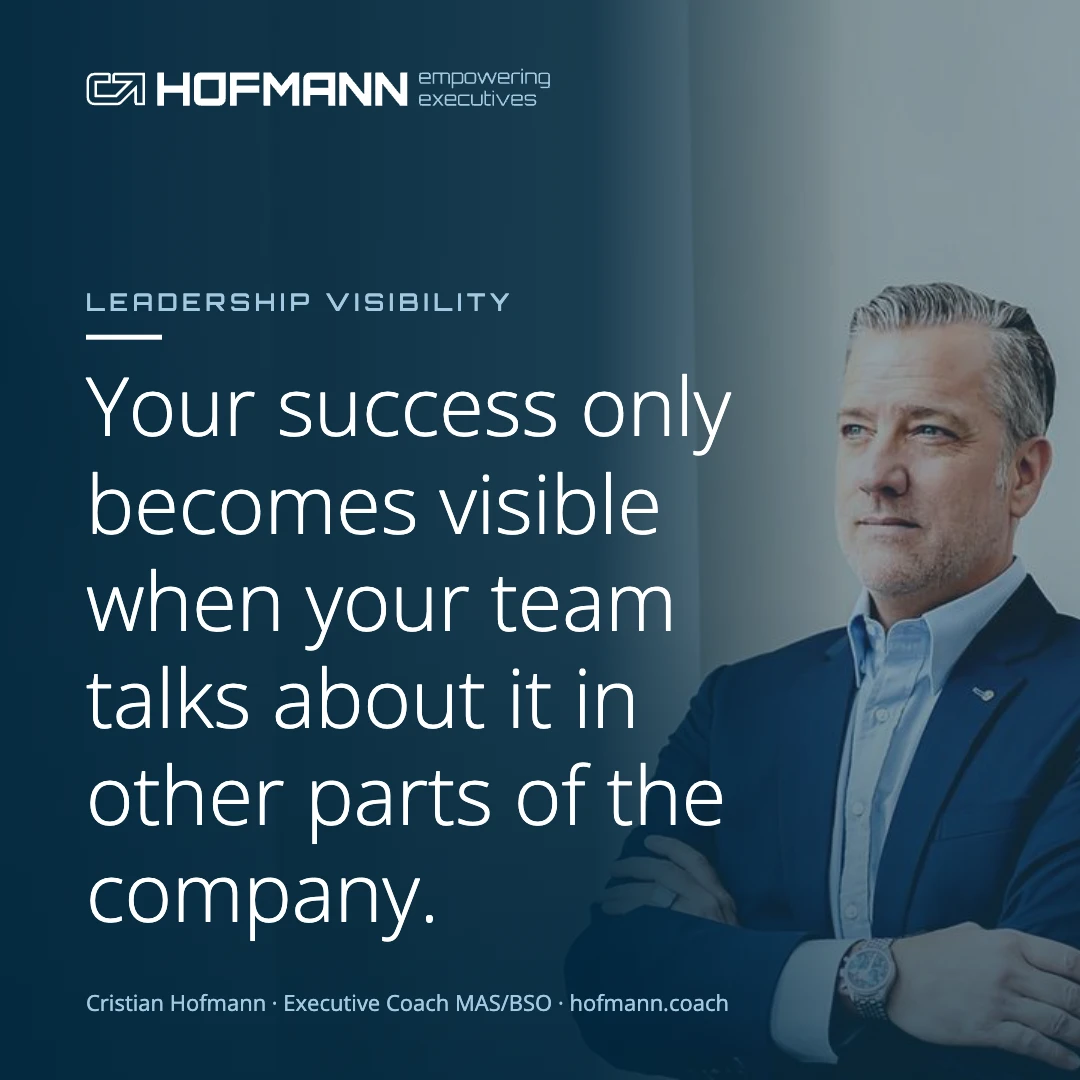
For your visibility, this means: People who feel understood carry your results further. Word spreads to other departments about how your team works and what comes out of it.
This kind of leadership visibility is hard to stage, because it grows from many small encounters that your team experiences as fair and respectful.
Leadership success depends heavily on personality traits. Willingness to learn and curiosity are part of it, as are openness to new things, the ability to take criticism and resilience. Classic traits such as intelligence, determination, charisma and integrity add to that. How these traits show in daily work is something you can develop deliberately.
In my coaching engagements I often see a particular mix in leaders whose success gets noticed across the whole company: Self-confidence with modesty. These leaders make clear decisions and still listen when someone disagrees.
A second trait concerns the team. Satisfied employees show high intrinsic motivation, identify with their task and the business, and deliver good work. Successful leadership keeps a balance between the benefit to employees, customers and the company, and above all retains the talents who can motivate themselves.
In his book “Führen Leisten Leben” (in English “Managing Performing Living”), the St. Gallen management thinker Fredmund Malik describes six principles of effective leadership. He sees them as the foundation of professional management, and they shape a company’s culture.
Focus on results makes success measurable. Contribution to the whole makes it relevant to other departments. Concentrating on a few things keeps your results from getting lost in the noise.
For Malik, using strengths also means deliberately accepting weaknesses. Trust is the principle that matters most in the end. Positive, constructive thinking helps you see opportunities and protects you from being steered by passing moods.
These principles work together. Results without trust make you visible as well, though as someone people don’t like working with.
To make your success visible, you need sharp positioning. Put into two sentences what you stand for in the organisation and what you expect from your area. Both sentences should be concrete enough that a new team member can repeat them after a week.
You shape role and status through recurring appearances. Pay attention to how you report results to the executive board and to whom you credit successes. Paradoxically, if you name the team, you’re seen more clearly as the leader yourself.
You also have to secure this position. Report results regularly and in the same format, so the people around you can see developments over time.
A simple test for your leadership visibility: Ask three colleagues from other departments what your area stands for. If their answers match your two sentences, your position has landed.
Leadership visibility follows substance, with some delay. In my experience, executives who work on their visibility first and their leadership second lose trust quickly, often with exactly the people they wanted to convince.
I still have one doubt. In large matrix organisations, good work sometimes stays invisible because too many layers sit in between. Modesty has a limit there: If you never report your results yourself, you leave the interpretation to others.
So my advice: Relationships and results first, then a deliberate, regular report on them. In that order, leadership visibility holds even when a quarter goes badly.
Through regular results reports with the same structure, and through your team talking about its work. Seek contact with areas that depend on your results. That’s where your reputation forms fastest. Use handovers too: If you hand a project over cleanly to another area, people there remember you well.
In dealing with people, modesty almost always helps. When you report results, it can hurt, because your contribution then gets attributed to nobody in particular. Keep the two apart deliberately.
LinkedIn can add to how you’re seen externally, for example with insights into your leadership work. Your standing inside the organisation still forms in meetings, conversations and results, and LinkedIn rarely changes that.
Think in quarters. A new positioning needs several reporting cycles before other areas repeat it. After a visible success it goes faster, after a false start more slowly.
Further reading on hofmann.coach: Leadership lives in the minds of those you lead · 16 tips for leaders to use the power of language · Executive coaching Zurich · Charisma: How leaders gain aura and standing · Top executive: Raising impact and standing in the leadership team
Note: This article was first published on 26.11.2018 and was revised and expanded in October 2026.
Cristian Hofmann is an executive coach in Zurich and Schaffhausen (MAS Coaching & Supervision BSO, Forbes contributor). Over more than 20 years he has coached more than 1,500 leaders: CEOs, executive boards and leadership teams in Switzerland, with measurably agreed goals and, on request, pay-for-results. More about Cristian Hofmann.