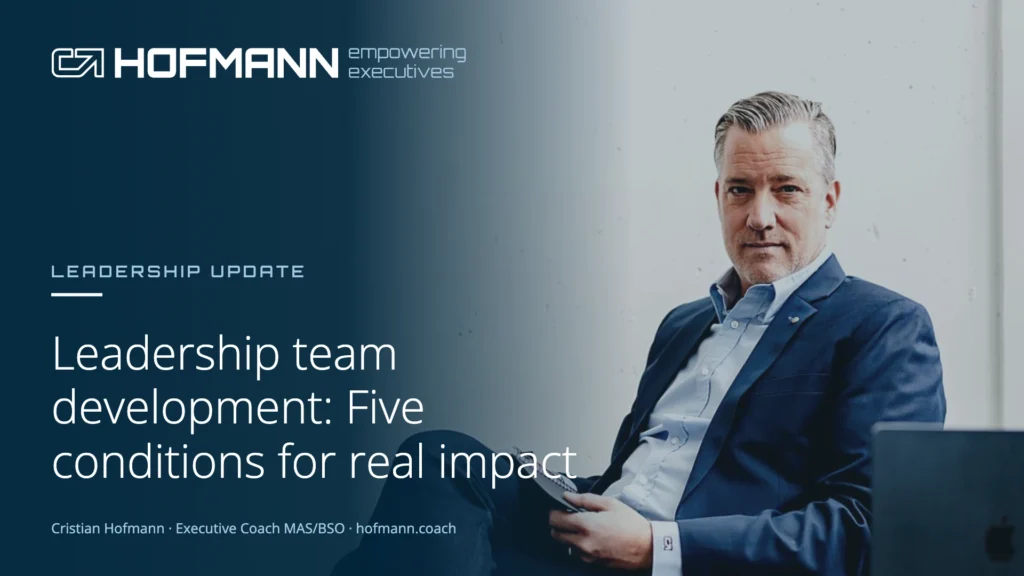
Leadership team development works when a team shares a goal and reflects honestly and regularly on what helps its collaboration and what slows it down. High-performing leadership teams are built through a conscious effort by the whole team.
Leadership team development means making an executive board or leadership team more effective as a unit. The focus is on the team's goals, its collaboration and what its members learn together. Individual growth is the subject of leadership development.
Executive leadership teams are formed to achieve results. A performance-oriented leadership team meets or exceeds its goals. In an effective team, every leader is focused on their role, and each member knows what's expected of them.
One of the biggest obstacles is perception. Many leaders assume their team members already know how to work together effectively. In practice I meet executive boards that bring together first-class individuals and still have no shared model for how they want to work as one team.
An effective leadership team keeps working on its performance. Members reflect on their work regularly and say openly what needs to improve. Over time, the team gets stronger and its success lasts longer.
Where it typically gets stuck in daily work, for example around decision rules and interfaces, is described in Team collaboration: How individuals become a leadership team.
The aim of executive team coaching is cohesion and a shared focus. Together, the team clarifies what it wants to achieve, how it wants to proceed and how it wants to be seen by its stakeholders.
An executive team coach provides a protected space, in time and place, and leads a careful reflection in it. What was previously unconscious or undiscussable comes onto the table. When the implicit becomes explicit, members understand each other's perspectives better.
That builds connection and trust, the basis of greater effectiveness. Members learn together, and the effect spreads into the organisation. Meetings become more constructive, tensions become manageable and conflicts get resolved. And yes, the work can be fun.
In team coaching, the contracting party is the team as a whole. The team leader is part of it, as a member of that team.
The effectiveness of a leadership team can be measured. Three measures have proven useful:
Performance. Are members satisfied with the team's performance? Measure this through relevant external feedback as well, for instance from the board or division heads.
Development over time. Is the leadership team becoming more effective, quarter by quarter?
Impact on individuals. What effect does the team have on its members and its leader? Measure what individuals gain in learning, skills and experience.
These measures largely match the criteria the Harvard psychologist J. Richard Hackman set out for team effectiveness in 1987: Output, social processes and learning (overview: Team effectiveness).
Whether a leadership team is set up for success shows in five conditions:
Unity. The team has a clear identity, a clear focus and clarified roles.
A compelling purpose. Team goals are developed together, clear and accepted by everyone.
Diversity. Knowledge, experience and skills come from different disciplines.
Structure. Clear working agreements and norms carry the team. In practice, norms that aim at solutions contribute a great deal to success. More on that in Solution-focused culture: How leaders move conflict forward.
Context. The organisational context leaves room for trust, appreciation, recognition and co-creation.
This list follows the conditions Hackman described for effective teams in 2002, such as a real team, a compelling direction and an enabling structure. Once these conditions are in place, development has a solid foundation.
Leaders who start on leadership team development usually underestimate the courage honest reflection takes. Discussing successes and setbacks openly means questioning your own behaviour in front of peers at the same level.
My position: A leadership team gets better when it talks honestly and regularly about how it works together. One workshop a year is rarely enough.
I do object to the extreme. A team that only talks about itself loses sight of the market. Reflection needs a fixed slot and a limit; otherwise it turns into a substitute for decisions.
First agreements can be made in a single workshop. Until new habits hold, it usually takes several months of regular reflection. What matters is that the team puts work on itself in the calendar.
The whole leadership team, including its leader. A team coach's mandate covers the team as a unit. If individual members keep missing sessions, that becomes the first topic.
Look for topics that keep coming back without a decision, and for agreements that get renegotiated after the meeting. Another signal: The divisions hit their targets, while the company as a whole misses its own.
Yes, with the three measures of performance, development over time and impact on individuals. With clients, I agree measurable goals for this, for example with 360-degree feedback at the start and at the end. On request, I work on a pay-for-results basis.
Further reading on hofmann.coach: Top management team: How to make excellence visible · 14 critical components of successful team-building activities · Inspirational leadership team
Note: This article was first published on 12 December 2022 and was revised and expanded in October 2026.
Cristian Hofmann is an executive coach in Zurich and Schaffhausen (MAS Coaching & Supervision BSO, Forbes contributor). Over more than 20 years he has coached more than 1,500 leaders: CEOs, executive boards and leadership teams in Switzerland, with measurably agreed goals and, on request, pay-for-results. More about Cristian Hofmann.