Assertiveness as a leader comes from clarity: You know what you want, you say it plainly, you live it and you show what happens when expectations aren’t met. A harsh tone is rarely needed for that.
Assertiveness is the ability to carry through your own goals and decisions, even against resistance. In leadership, it shows in whether other people follow a direction because they understand it and back it. In daily work, you can recognise it by a simple signal: Decisions hold even when you’re not in the room, and your team can explain why they were made.
Many leaders ask themselves whether they’re tough enough. My answer has been the same for years: If you feel you’re not tough enough, it’s often because you aren’t clear about what you want.
Good leadership becomes visible in how well you manage to inspire other people and spark enthusiasm. That only works if the relationship between leader and employees is right.
Then there’s orientation. Leadership is focused, intentional and goal-oriented, and it gives meaning. Orientation and meaning inspire people, and if you inspire, you assert yourself more easily. Whether leadership works is decided by the people being led. More on this in Leadership lives in the minds of those you lead.
“Know what you want.” As a leader, you first need to know where you’re heading. Our world is complex, so it pays to structure things and create clarity. A simple test: Can you say in two sentences what your area should have achieved in twelve months? If you can’t, every attempt to assert yourself turns into a negotiation over individual cases.
That north star then has to be communicated clearly, ideally through convinced leadership behaviour. Only then does it have an effect on others.
There’s no way around this: Act as a role model yourself. Show how you make a positive difference as a leader. Impact is what leadership is about.
Make clear to your employees what happens when expectations aren’t met. In that moment you are tough, and you use the power that comes with leadership. Consequences work when people know them in advance and when they then actually follow. Announced consequences that never come weaken every later announcement.
This forcefulness belongs to your role as an enabler. It serves development and helps employees make the best contribution they can.
Explore the desired future together with your employees. That way everyone sees more clearly, and the route to solutions that work gets shorter. If you manage to raise the readiness for change with positive emotions and creativity, you have motivated people successfully.
I like to compare this to balls in the air: Leadership, power and purpose. As long as you keep them all up, you convince people and can assert yourself, depending on your intention. I describe the connection in more detail in Power. Leadership. Purpose?
If power drops away, what remains is friendly vagueness. If purpose is missing, asserting yourself turns into pressure, which works in the short term and costs trust in the long term.
When leaders look for more assertiveness, they often think first of a tougher manner. In coaching, we usually get quickly to the question of what they want. That’s where the bigger lever lies.
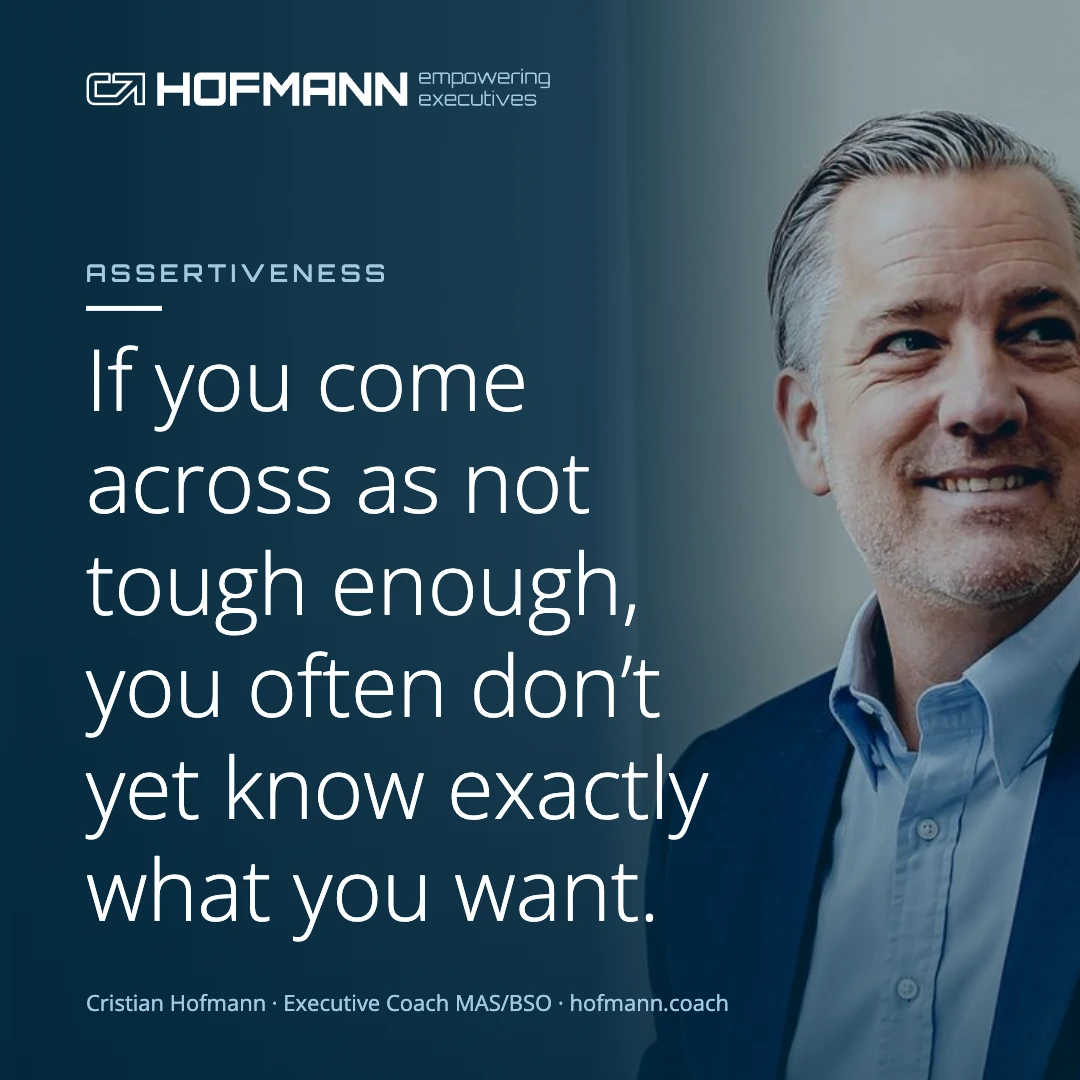
My position: If you come across as not tough enough, you often don’t yet know exactly what you want. Once that clarity is there, language and manner usually change by themselves.
I consider the opposite extreme more costly. Toughness without purpose produces obedience for a while and resistance under the surface. If you assert yourself mainly through consequences, you lose the people you’ll need for the next change.
First clarify what you want, and put it so that others can repeat it. Live it and name the consequences when expectations aren’t met. Your ability to assert yourself grows with that clarity.
Firmness is needed in one place: Following through when expectations aren’t met. A harsh tone buys obedience in the short term and costs trust over time.
First check whether the decision and its purpose have been communicated clearly. Often orientation is missing. Ask specifically what is unclear or what speaks against it. Then make clear which consequences follow, and keep your word.
Yes, especially with the question of what you want. A coach asks the questions that get lost in day-to-day business and mirrors how you come across to others. On request, I work with measurable goals and Pay-for-Results.
Further reading on hofmann.coach: Executive presence: How to build standing and impact · 15 ways for best outcomes from difficult conversations · 15 effective and tactful ways to challenge the boss’s idea
Note: This article combines two articles from 02.05.2019 and 17.05.2019 and was revised and expanded in October 2026.
Cristian Hofmann is an executive coach in Zurich and Schaffhausen (MAS Coaching & Supervision BSO, Forbes contributor). Over more than 20 years he has coached more than 1,500 leaders: CEOs, executive boards and leadership teams in Switzerland, with measurable goals and, on request, pay-for-results. More about Cristian Hofmann.