Changing city or country for a job means competing against local candidates who can start on Monday. The employer has one question: Will this person really come, and will they stay?
In 2020, Forbes asked 15 members of its Coaches Council how job seekers impress employers in another state. I was one of them. The advice was written for the US. Most of it applies to a Swiss executive moving to Singapore, or a German manager moving to Zurich, which is the kind of move I see in international business coaching.
Candidates who reach the final round and then hesitate about relocating frustrate employers. Show an unwavering commitment. Mention what you see as the benefits of the move, so nobody second-guesses your seriousness.
Origin: Mark Gasche, North Shore Career Management
The right-fit candidate is the most competent and the least risky hire. Research the location, explain why now is the right time, and say how the place fits your life: Family there, schools, a long-term reason. Be honest. A vague reason reads as a short stay.
Origin: Debbie Ince, Executive Talent Finders
Make the reality of your timeline clear, and make it just as clear that you're the right candidate, through follow-up that adds something. Many people play "wait and see". Reach out regularly and purposefully to your main contact, with energy. Energy lands, even by email.
Origin: Dena Breslin, DenaB Coaching
Having hired more than 1,000 people, one panellist looked for one thing above all: Certainty. The right answer to "Why should I hire you?" is "Because I'm certain I can do the job", backed by something you can prove. Experience, training, a visible cultural fit.
Origin: Steven Pfrenzinger, Self-Awareness Coach to Entrepreneurs
Wherever you apply, employers look for the same thing first: A genuine interest in their success. If you want to stand out, show that you care whether the company meets its objectives. People who are there for the paycheck are easy to spot and easy to replace.
Origin: Roger Doumanian, The Roger Doumanian Corporation
If the role requires relocation, bring examples of how you adapted through big change before. Leadership and creativity in those moments show tolerance for ambiguity, maybe even appetite for it. Hiring managers read that as the ability to thrive in a new environment.
Origin: Marnie McLain, Marnie McLain Coaching
With high competition, doing what everyone does makes you invisible. The biggest pain for HR is preselection. Help them get to know you fast: A 60-second video that shows what you add to the company, for example. Make the first filter easy for the person holding it.
Origin: Michael Thiemann, Strategy-Lab
Candidates who move countries or continents should build their local network before the move. Target forward-thinking companies that value the insights and ideas your geographical and cultural background brings. Then use that background openly instead of hiding it.
Origin: Jelena Radonjic, WhatWork Career Coaching
Explain your relocation plans in the CV and in the interview: Where, when, why. Don't appear desperate, or the hiring manager will suspect you want a relocation ticket rather than their job. You're moving to that area anyway, and this employer is lucky you are.
Origin: Dan Hawkins, Summit Leadership Partners
Start the search right away. In every contact with your network and with hiring managers, lead with your value and your expertise. Make it visible, relevant and hard to resist. And save everyone time by applying only for jobs you truly qualify for.
Origin: Izabela Lundberg, Legacy Leaders Institute
Living in Chicago but applying in Miami? A free local number through Google Voice sends a signal and helps you surface in local recruiter databases. If you have family in the area, ask whether you can use their address. Small details, visible effect.
Origin: Scott Singer, Insider Career Strategies
Drop the traditional CV in favour of a personal biographical summary in the first person: Why you want to relocate, why you chose this company, and your proudest accomplishments. Hiring managers are tired of boring CVs. This one gets read.
Origin: Cheryl Czach, Cheryl Czach Coaching and Consulting
This one is mine, and it's the one I'd still put first. Get to know the culture and customs of the region before you move. Ask locals and people inside the company. Learn the company culture, its values and the behaviour it expects. Then show up with your authentic personality and lead as a role model. Executive presence travels, if it's real.
Origin: Cristian Hofmann, Empowering Executives, SUPERGROUP AG
Companies watch every hire that brings extra cost, and relocation is extra cost. Show them you're a fit, and show the specific impact that only you bring. Add evidence that you intend to commit to the company's success, so the investment is safe.
Origin: Amy Nguyen, Happiness Infinity
Relocating doesn't have to make the search harder. Search as if you were local. Contact people in your target role at your target companies and ask for short networking conversations by video. If it goes well, ask for an introduction to the hiring manager or tips on your application.
Origin: Kyle Cromer Elliott, CaffeinatedKyle.com
Twelve of the 15 strategies answer the employer's hidden question: Is the risk of this hire lower than it looks? Commitment, homework, local network, clear intentions. The candidate's job is to make the risk visible and then remove it.
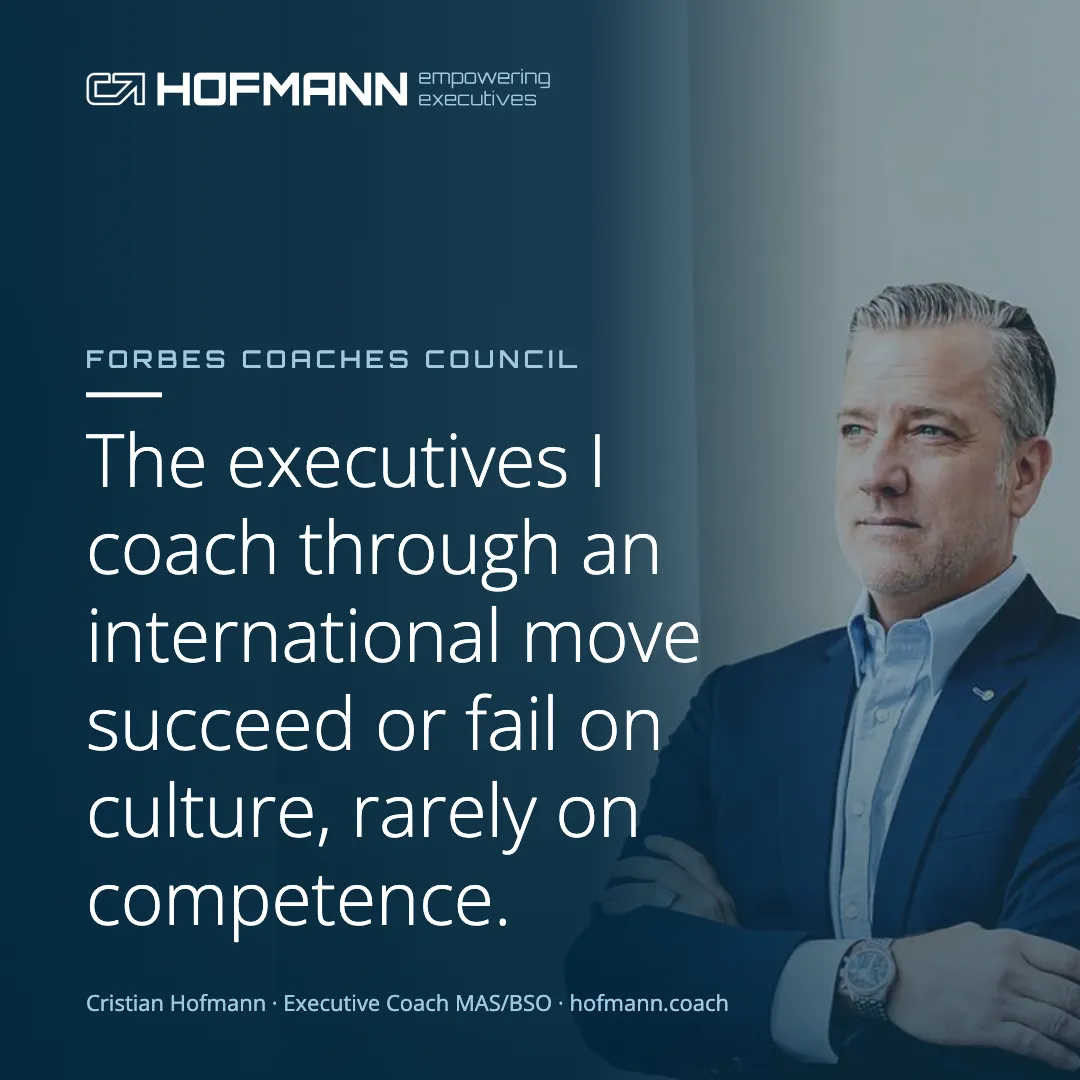
Whether every strategy transfers from the US to Switzerland, I doubt it. A local phone number impresses nobody in Zurich. What transfers completely is point 13: The executives I coach through an international move succeed or fail on culture, rarely on competence.
Further reading on hofmann.coach: 11 tips for professionals updating their CV mid-career · How new leaders develop and manage relationships · Executive Coaching Zurich
Note: The 15 strategies come from the Forbes Coaches Council expert panel "Relocating? 15 Concrete Strategies To Impress Out-Of-State Employers", published 19 May 2020. Contribution no. 13 is my own. My reading of the other fourteen is mine, and it isn't a quote of my colleagues' wording.
Cristian Hofmann is an executive coach in Zurich and Schaffhausen (MAS Coaching & Supervision BSO, Forbes contributor). Over more than 20 years he has coached more than 1,500 leaders: CEOs, executive boards and leadership teams in Switzerland, with measurably agreed goals and, on request, pay-for-results. More about Cristian Hofmann.