Peer coaching is its own craft. Put six leaders or six coaches at one table and the learning runs between them, while the coach holds the frame. That sounds easier than it is, and most of the mistakes I see are made by people who are excellent in one-to-one work.
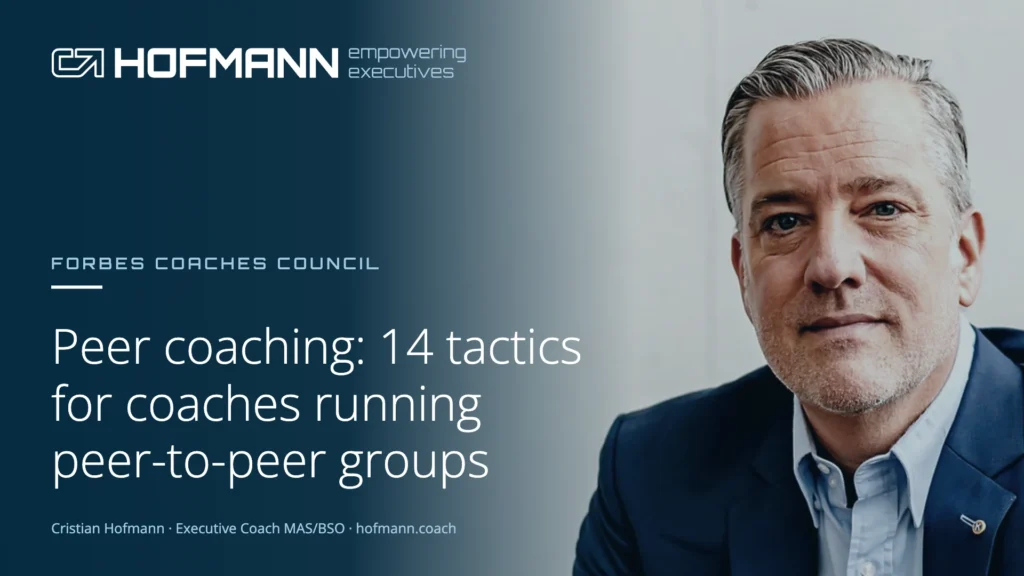
In March 2022, Forbes asked 14 members of the Forbes Coaches Council which tactics had proven themselves when running peer-to-peer groups. My contribution is number 12.
The order below follows the original. The reading is mine, from intervision groups and leadership teams in Switzerland.
Vered Kogan gives every member equal air time and asks for respect toward views they reject, and the coach models it. In my groups, anyone who disagrees first summarises what they heard. After that they may take it apart.
Source: Vered Kogan, Momentum Institute
Shelley Smith advises learning early how each person communicates and decides. The quicker the coach gets this, the sooner the group treats him as a peer rather than a teacher. In the first session I have everyone describe how they prefer to be criticised.
Source: Shelley Smith, Premier Rapport
Michael Couch runs speed peer consulting: The group analyses one problem together, then each member commits to a specific action. The next session opens by debriefing those commitments. What worked, what did not, and why. Those ten minutes separate a dinner club from peer coaching.
Source: Michael Couch, Michael Couch and Associates Inc.
Heather Murphy sends material ahead and time-blocks the meeting. A recap follows to everyone. It sounds basic and fails constantly. A group that shows up unprepared three times has learned that preparation does not matter. The coach taught them.
Source: Heather Murphy, Authentically: Business & Life Solutions
Jarret Patton calls listening the most important tactic in groups, silence included. Silence can mean uncertainty or low trust, and if nobody looks, it ends with members leaving. I name silence without interpreting it: "It has gone quiet. What happened?"
Source: Jarret Patton, DoctorJarret PLLC
Yvette Costa describes the trap when the peer group consists of coaches: Everyone wants to coach, nobody wants to be a colleague. Clear ground rules at the start, stating that this is a peer session, keep people in role. In peer coaching among coaches this is the intervention I make most often.
Source: Yvette Costa, Velocity Advisory Group
Palena Neale contracts with the group on norms, including equal rights and duties for all participants. Equal membership status is the basis for psychological safety. With a listed company and a family business in the same room, that means: Titles stay at the coat rack.
Source: Palena Neale, unabridged
Natalie McVeigh reminds us that ground rules get broken by everyone, the coach included. If you want the group to become self-sustaining, keep its rules visibly yourself. I ask the group to call out my violations first.
Source: Natalie McVeigh, EisnerAmper
Julie Colbrese trains participants to ask strong questions and to give feedback by agreed rules. The knowledge sits in the room, and the coach switches it on. By the third session a good peer group should manage an hour without its facilitator.
Source: Julie Colbrese, Hot Coffee Coaching
Jeffrey Deckman checks himself with the acronym WAIT: "Why am I talking?" Your own thought is rarely important enough to interrupt the group's work. I count my own contributions in a session. More than six per hour means the group worked too little because I talked too much.
Source: Jeffrey Deckman, Capability Accelerators
Lisa Marie Platske creates safety and respect for each person, because peer work rests on a "we-leadership" model in which everyone brings their own expertise. Openness and collaboration appear once nobody has to fear looking stupid for asking.
Source: Lisa Marie Platske, Upside Thinking, Inc.
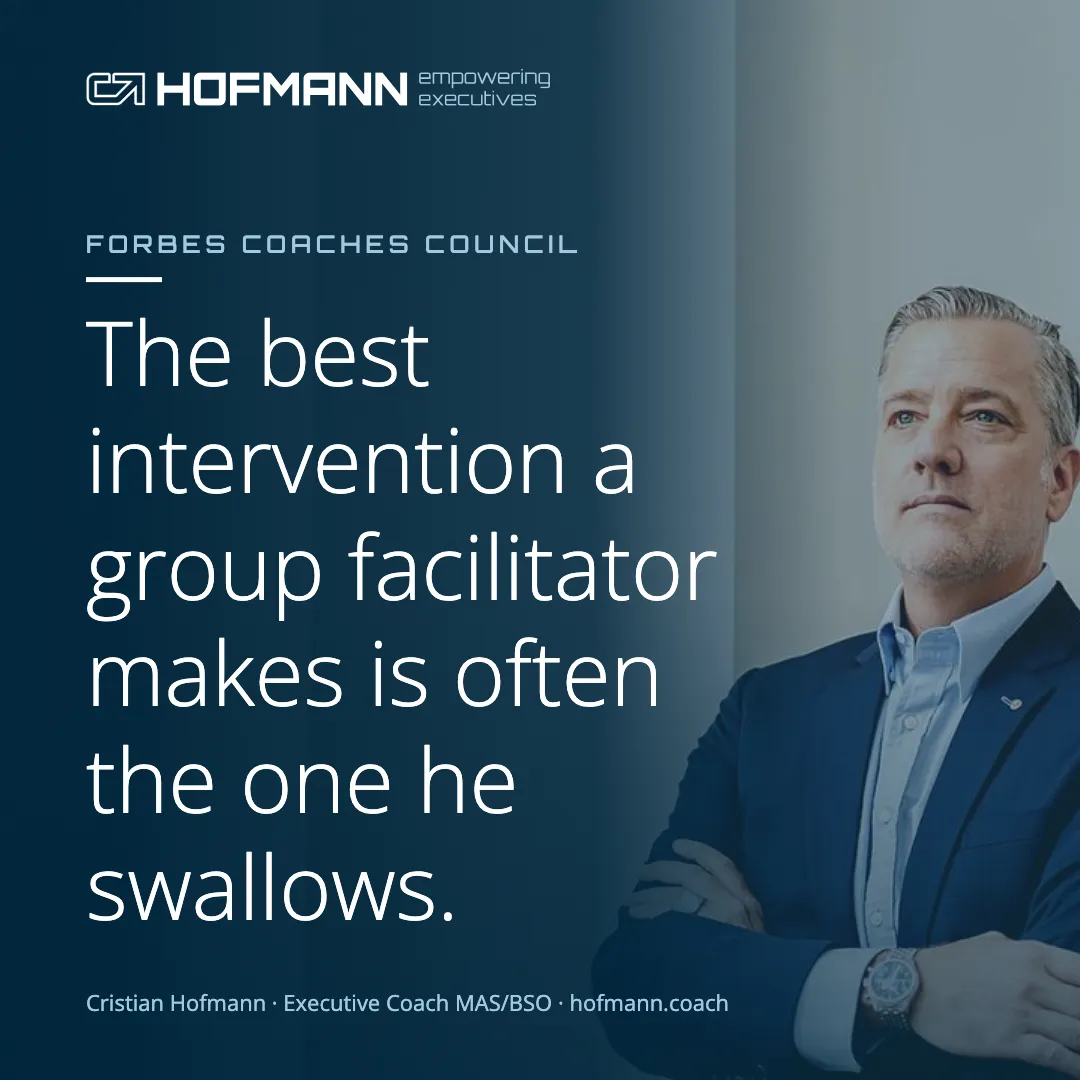
My contribution to the panel. Peer learning is bound to no method. If the joint discussion shows that a classic seminar is the right next step, then that is the step. A mix usually works best: Formal and informal formats, on-the-job training, mentoring, self-study with discussion in the group. The group decides, and the coach reflects the chosen tactic with them.
Source: Cristian Hofmann, Empowering Executives | SUPERGROUP LTD
Gregg Ward sees trust collapse the moment a strong personality takes over the group. Peer-to-peer groups rest on mutual respect, and nobody bullies anyone into anything, the coach included. I slow the know-it-all down with a task: Summarise the others' positions before you present your own.
Source: Gregg Ward, The Center for Respectful Leadership
Arthi Rabikrisson asks each member the same question in a slightly different form. It prevents formulaic answers and keeps everyone present, because nobody can borrow the previous answer. Breadth comes first, then depth.
Source: Arthi Rabikrisson, Prerna Advisory
Four years later the demand for peer coaching has moved. Today it is mostly executive boards asking, because they want to run their leadership meeting as a peer group. Everything above applies there, with one complication: The CEO sits at the table, and hierarchy is hard to leave at the coat rack.
My rule for peer coaching with executive boards: The CEO speaks last in every round, and his commitments are logged like everyone else's. After three sessions the group notices that the boss's word in the room weighs less than his behaviour afterwards.
Further reading on hofmann.coach: Executive Coach · Shared leadership · How leaders resolve conflicts constructively
Note: This page goes back to the Forbes Coaches Council expert panel "14 Essential Tactics For Coaches Running Peer-To-Peer Groups", published 18 March 2022. The commentary is mine.
Cristian Hofmann is an executive coach in Zurich and Schaffhausen (MAS Coaching & Supervision BSO, Forbes contributor). Over more than 20 years he has coached more than 1,500 leaders: CEOs, executive boards and leadership teams in Switzerland, with measurably agreed goals and, on request, pay-for-results. More about Cristian Hofmann.