A leader as coach develops people one by one and makes sure the team works well as a whole. That builds trust within the team, and the leader’s own standing grows with it. I see this role as an answer to two problems I come across in companies again and again.
The video above is about a diagnosis in one company that brought exactly these two problems to light. First, there was a lack of trust in teams that are supposed to deliver efficiently and produce results. Second, executives were worried about losing power if they handed over responsibility.
The term leader as coach describes a leadership style in which managers develop their people mainly through good questions and honest feedback. Solutions come out of the conversation more often, and responsibility for delivery sits with the team member.
Organisations need a different kind of leadership. The amount of leadership stays the same; the style changes. Whoever used to have the best answer now asks the best question more often.
In his 1990 book “The Fifth Discipline”, Peter Senge described the learning organisation: a company in which people keep expanding their capabilities and learn together. Leadership takes on a new job there. It creates the conditions in which others learn.
Working as a high-performance team takes new skills and knowledge. That’s where the leader as coach steps in, in everyday work: in the project meeting, or in the simple question “What would you suggest?”
On the individual level, the leader develops each team member in a targeted way. That means agreeing on development goals and handing out work that people can grow into.
In conversation, this sounds unspectacular. Someone brings a problem, and the leader asks first: “What have you tried so far, and what would your next step be?” Advice comes afterwards, if it’s still needed.
On the level of collaboration, the leader makes sure the team works effectively and delivers results. The questions are practical: Who decides what, and how does the team learn from mistakes?
A simple tool is a short review at the end of each month: What cost us time, and what will we do differently next month?
The two levels depend on each other. Strong individuals fizzle out in a poorly coordinated team, and a well-coordinated team stalls when the individuals stop growing.
The worry about losing power is understandable. If you’ve led for years through expertise and your own decisions, handing over responsibility means giving up a piece of security.
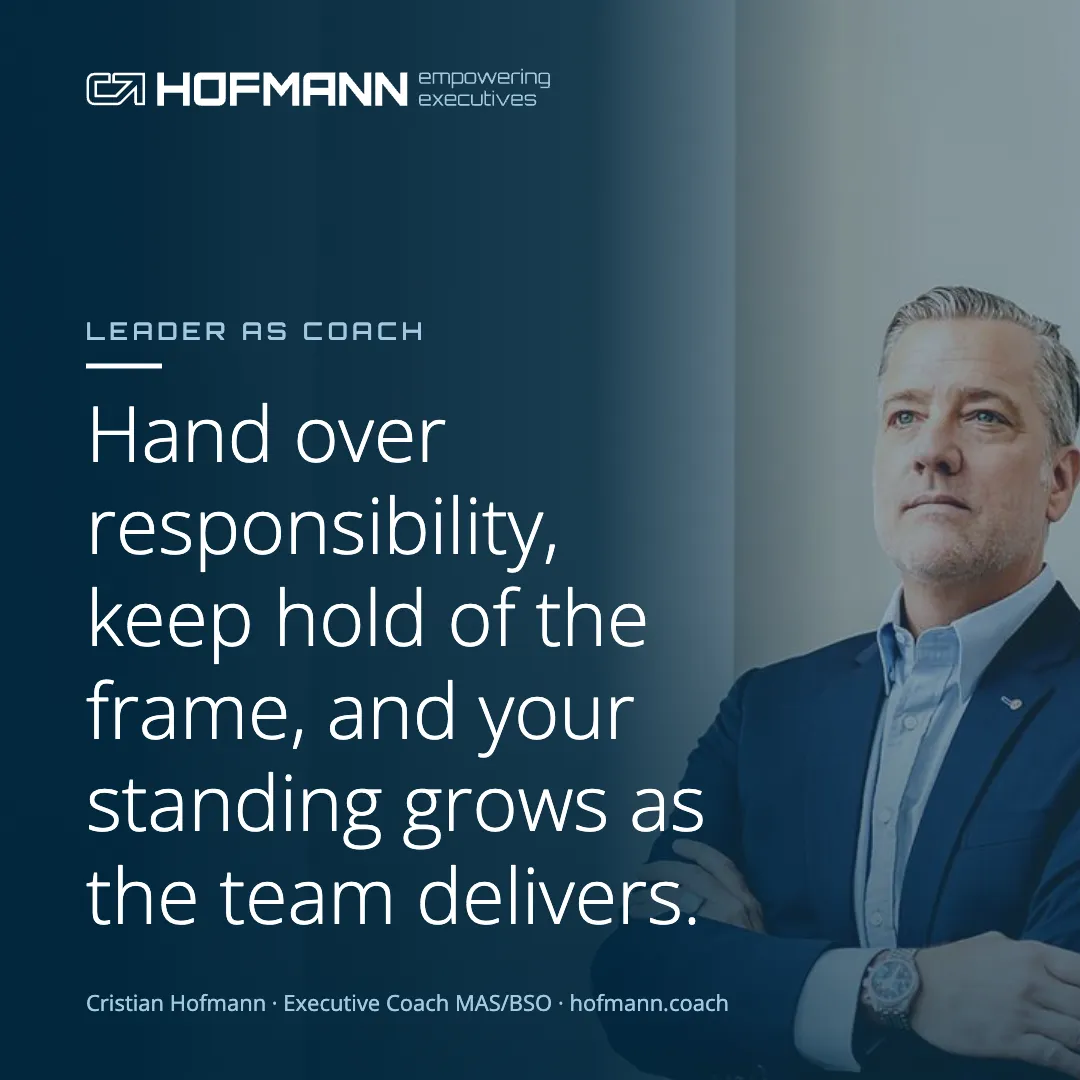
In practice, a leader as coach keeps hold of the frame: the goals and the limits within which the team decides for itself. What gets handed over is the route. How to make that handover work is the subject of Empowering Leadership: What It Means and How to Embrace It.
Your standing grows by a different route than it used to. It comes from a team that visibly delivers and from people who say they learned something working for you.
Trust grows when people find that their suggestions count. A leader who asks and then takes the answer seriously sends a clear signal. Ask and then decide everything yourself anyway, and you lose that trust faster than you built it.
Reliability is part of it. Agreed decision-making room still applies when things get tight, and mistakes made within that room get discussed without anyone being punished.
Trust also runs both ways. A team trusts its leader more readily once the leader has trusted the team first.
For teams that need to be able to do more tomorrow than today, I think the leader as coach is the right answer. Most leaders I work with soon find that asking is harder work than instructing, and that it lasts longer. The biggest effect shows up where leaders change their own behaviour first and only then expect more ownership from the team.
There’s an honest limit. A leader assesses performance and decides on pay and promotion, and everyone in the team knows it. So a conversation with your own boss rarely becomes fully open, however good the questions are.
In a crisis, clear instructions are sometimes what’s needed. The skill lies in recognising which role the moment calls for, and telling the team.
It describes a leader who develops people through questions and feedback and shapes how the team works together. A leader as coach hands over responsibility and keeps the frame, so trust grows and the team learns on the job.
Only partly. An external coach is independent and has no say in your appraisal, so different conversations become possible. For development in day-to-day work, your own manager is closer to the action.
Start in your next one-to-one: ask first, advise second. Hold the silence when an answer takes a moment. Feedback from your team or coaching of your own helps you spot your blind spots.
Further reading on hofmann.coach: Leadership development: 15 ways to turn leadership weaknesses into strengths · About Cristian Hofmann, executive coach · Solution-focused culture: How leaders move conflict forward · Top management team: How to make excellence visible
Note: This article was first published on 04.07.2023 and was revised and expanded in October 2026.
Cristian Hofmann is an executive coach in Zurich and Schaffhausen (MAS Coaching & Supervision BSO, Forbes contributor). Over more than 20 years he has coached more than 1,500 leaders: CEOs, executive boards and leadership teams in Switzerland, with measurably agreed goals and, on request, pay-for-results. More about Cristian Hofmann.