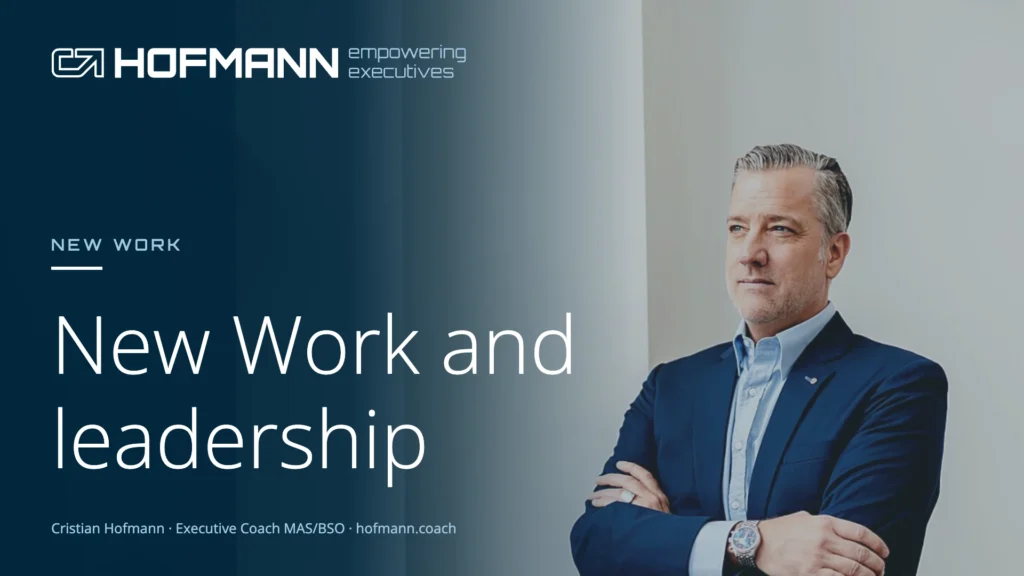
New Work asks leaders to create conditions in which teams take responsibility themselves and deliver good performance in work that feels meaningful. Instruction, control and activity for its own sake move into the background.
Simple tasks are losing importance, while tasks with high responsibility are gaining it. For this, leaders and employees need the ability to communicate and reflect, flexibility and the ability to build networks.
The term goes back to the social philosopher Frithjof Bergmann, who founded a Center for New Work in Flint, Michigan, in the early 1980s. He became known for his formula of work that you really, really want. Automation was his starting point: If machines take over paid work, it should be cut back for everyone, so that room for self-determined work opens up.
In everyday business, the term today stands for flexible workplaces and working hours, flatter hierarchies, more personal responsibility and a culture that allows new things. Rules on working from home are the smallest part of it.
If you’ve worked at the same company for a long time, you question structures less often and value the stability of well-practised routines. That’s human. For a company to stay fit for the future, it needs a vision plus the openness to welcome new things, and a culture that supports this.
This attitude includes values you can observe in daily work: Working with personal responsibility, meeting deadlines reliably, avoiding waste, improving continuously, focusing on the customer, raising problems quickly, honestly and courageously, and treating one another with respect.
These values sound obvious. Their weight only shows when they cost something: When a deadline can only be met with extra effort, or when a problem raised openly exposes a superior.
Values develop in daily work when leaders model them and involve their employees along the way. An order from above usually achieves the opposite.
That’s why the ability to transform and cultural development belong together, and both need time to take root in the company. How leadership shapes culture is the subject of Corporate culture: What you can change as a leader.
For agile structures and ways of working, I like to use the four value pairs from the Manifesto for Agile Software Development from 2001. They come from software development. Applied to leadership, they read roughly like this:
Individuals and interactions over processes and tools. A good conversation often solves more than a new tool.
Working results over comprehensive documentation. A process that runs takes priority over the perfect concept.
Customer collaboration over contract negotiation. Cooperation achieves more than any service specification.
Responding to change over following a plan. Plans give orientation, and they’re allowed to change.
Leaders shape things and let go of existing structures. In agile companies they step back, let teams organise themselves and make sure the conditions are good. Distributed leadership is part of this.
Leaders are still needed, though, to shield their teams and clear the way for them. Stepping in is right when the system’s self-stabilisation isn’t enough. Detailed task planning, nitpicking checks and lecturing tend to harm motivation.
If an organisation wants to deliver results efficiently and in the right quality, it needs routines and discipline in reaching goals. In this model, freedom and commitment belong together.
This shows quite concretely in a leader’s calendar. Status meetings shrink, and the time for clarifying goals, priorities and interfaces grows. So does the time for conversations in which employees can name their obstacles.
New Work takes time and can grow continuously. The foundations need laying now, though, and that only works with a leadership team that collaborates outstandingly well itself.
I push back clearly against one extreme: New Work as the abolition of leadership. Laissez-faire harms an organisation just as much as command and control. Teams that organise themselves need leadership that sets the frame and models what it expects.
A good way in is a simple question for the leadership team: Which decisions do we make ourselves today that our teams could make better? The honest answer usually shows quickly where the work begins.
Don’t leave yourself out here: If you demand self-organisation and pull every decision to yourself, you send two contradictory messages, and the team usually believes the second one.
Corporate culture and collaboration are among the most important success factors in digital change. Bring your employees along, because they’re the engine and the heart of your company.
Working from home is one building block. Personal responsibility, flatter hierarchies, a culture that allows new things and a changed leadership role are part of it too.
Yes. Their task is to shape: Set the frame, clear obstacles out of the way and step in when the team can’t get any further on its own. Without leadership, laissez-faire looms.
With the leadership team. Clarify there which values should apply and how you model them yourselves. Structures, working models and tools then follow step by step.
Agile structures are a common way to put the ideas into practice. They work when leaders hand over responsibility and at the same time make goals and priorities clear.
Further reading on hofmann.coach: Learning organisation: What defines it and how leadership sustains it · Excellence in shared leadership · Team collaboration: How individuals become a leadership team
Note: This article was first published on 29.05.2019 and was revised and expanded in October 2026.
Cristian Hofmann is an executive coach in Zurich and Schaffhausen (MAS Coaching & Supervision BSO, Forbes contributor). Over more than 20 years he has coached more than 1,500 leaders: CEOs, executive boards and leadership teams in Switzerland, with measurably agreed goals and, on request, pay-for-results. More about Cristian Hofmann.