Team collaboration is harder at the top than further down. Every member of an executive board runs an area of their own, with their own goals, budget and people. The leadership team itself often has nobody who leads its collaboration, apart from the CEO, who is rarely a facilitator.
The video above tells of a workshop with such a top leadership crew. Things were stuck at every corner: Responsibility was pushed back and forth, discussions went in circles, results did not come. The individuals were capable. Their collaboration was not yet.
Teamwork is complex and dynamic, and it needs coordination. Without rules for that coordination, patterns form and repeat until someone interrupts them on purpose.
In leadership teams I meet the same patterns again and again:
Endless loops. The same topic returns in three meetings because nobody clarified who decides.
Silent vetoes. Everyone nods in the room, nobody implements outside it.
Silo thinking. Each member defends their own budget, and nobody feels responsible for the overall result.
Conflict avoidance. Critical points get settled one to one and stay unspoken in the team.
Together with the team we created a framework for its collaboration. The most important element was the question of how the team decides. The goal was short, focused rounds with clear roles that end in a decision. In concrete terms, the team clarified four points:
Type of decision: Which topics does the CEO decide, which the team by consensus, which a single member after consultation?
Preparation: Who brings a topic to the meeting, and how prepared?
Objection: Objections belong in the meeting. Whoever objects outside stayed silent inside.
Implementation: Every decision has a name and a date.
That sounds trivial. In practice, exactly these rules break the same old patterns. Productivity, collaboration and satisfaction in this team sorted themselves anew within this framework.
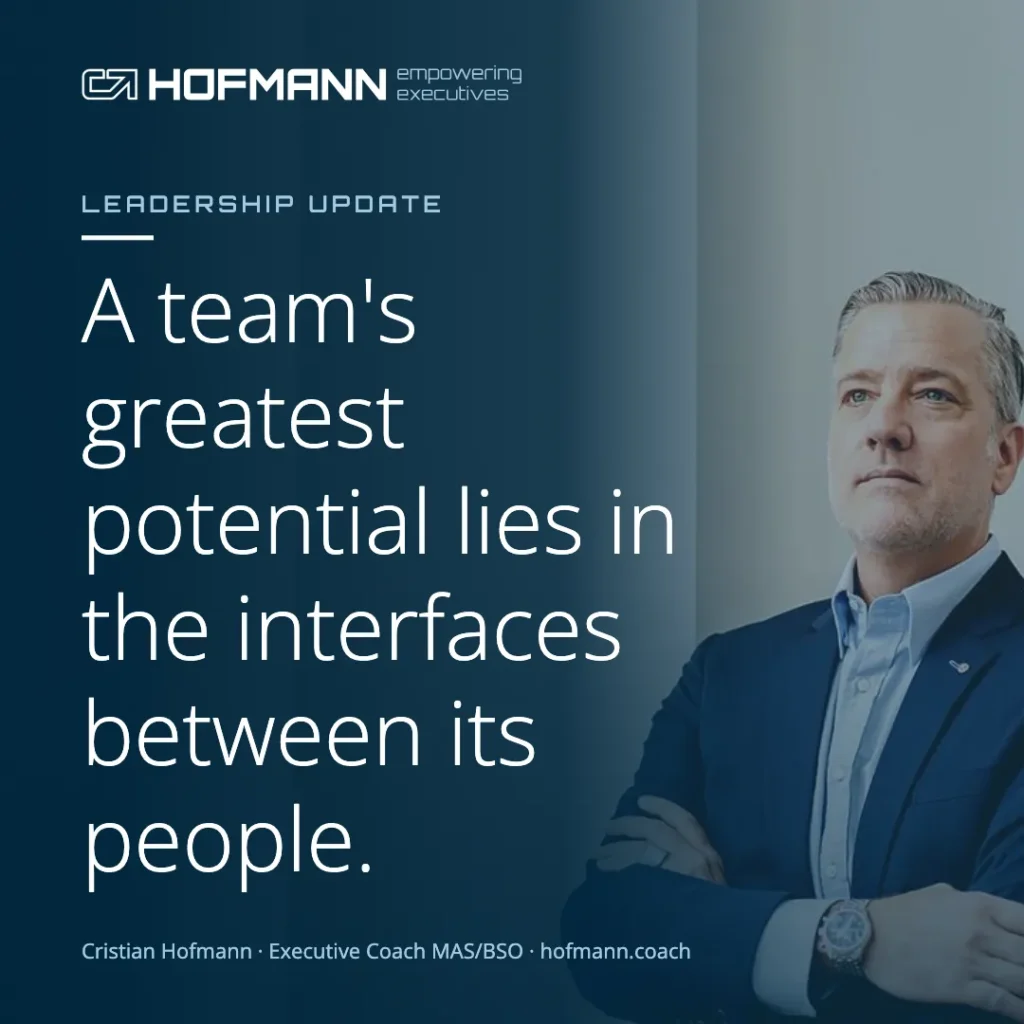
A team's greatest potential lies in the interfaces between its members. Individual top performers do not yet make a top team. The most important question for every leader is therefore: How well does my team work together?
Research backs this up. In «Project Aristotle», Google studied more than 180 teams and found psychological safety to be the most important factor for team performance: The belief that you can take a risk in the team without being embarrassed (Google re:Work, 2015). The concept goes back to Amy Edmondson of Harvard Business School.
Test your leadership team with five questions:
1. Does everyone know who makes which decision?
2. Do objections come up in the meeting or only afterwards?
3. When did the team last put the overall result above the interest of one area?
4. Does every decision have a name and a date?
5. Would a new team member know the ground rules after one month?
Two or more honest no answers mean: Team collaboration deserves its own slot on the agenda.
Team collaboration is complex and dynamic and needs coordination.
A clear framework, for decisions for example, replaces endless discussion with focused interaction.
A team's potential lies in the interfaces between its members.
That is how individuals become a committed, goal-focused high-performance team.
By topics that return without a decision, by agreements renegotiated after the meeting, and by conflicts that only surface one to one. Another signal: The areas reach their goals while the company as a whole misses its own.
A team that achieves more together than the sum of its members. It has a shared goal, clear rules for decisions and enough trust to voice disagreement openly.
First rules for decisions can be agreed in one workshop. Until they become habit, in my experience three to six months of regular reflection pass. After that the team carries the rules itself.
A view from outside with no interests of its own inside the company. A coach names patterns that nobody inside names, and holds the team to the agreed rules until they take hold.
This leadership crew managed to turn individuals with different skills into a committed, goal-focused team. If team collaboration is an issue in your executive board too, let's talk. More on my approach under Inspirational Leadership Team.
Further reading on hofmann.coach: Conflict management: What leads to a constructive conflict culture · Difficult conversations: 15 ways leaders get the best outcome · Shared Leadership · Top management team: How to make excellence visible · Co-leadership: How two leaders at the top make it work
Source: Google re:Work, Guide: Understand team effectiveness. The original article dates from October 2019, the text was revised in October 2026.
Cristian Hofmann is an executive coach in Zurich and Schaffhausen (MAS Coaching & Supervision BSO, Forbes contributor). Over more than 20 years he has coached more than 1,500 leaders: CEOs, executive boards and leadership teams in Switzerland, with measurably agreed goals and, on request, pay-for-results. More about Cristian Hofmann.