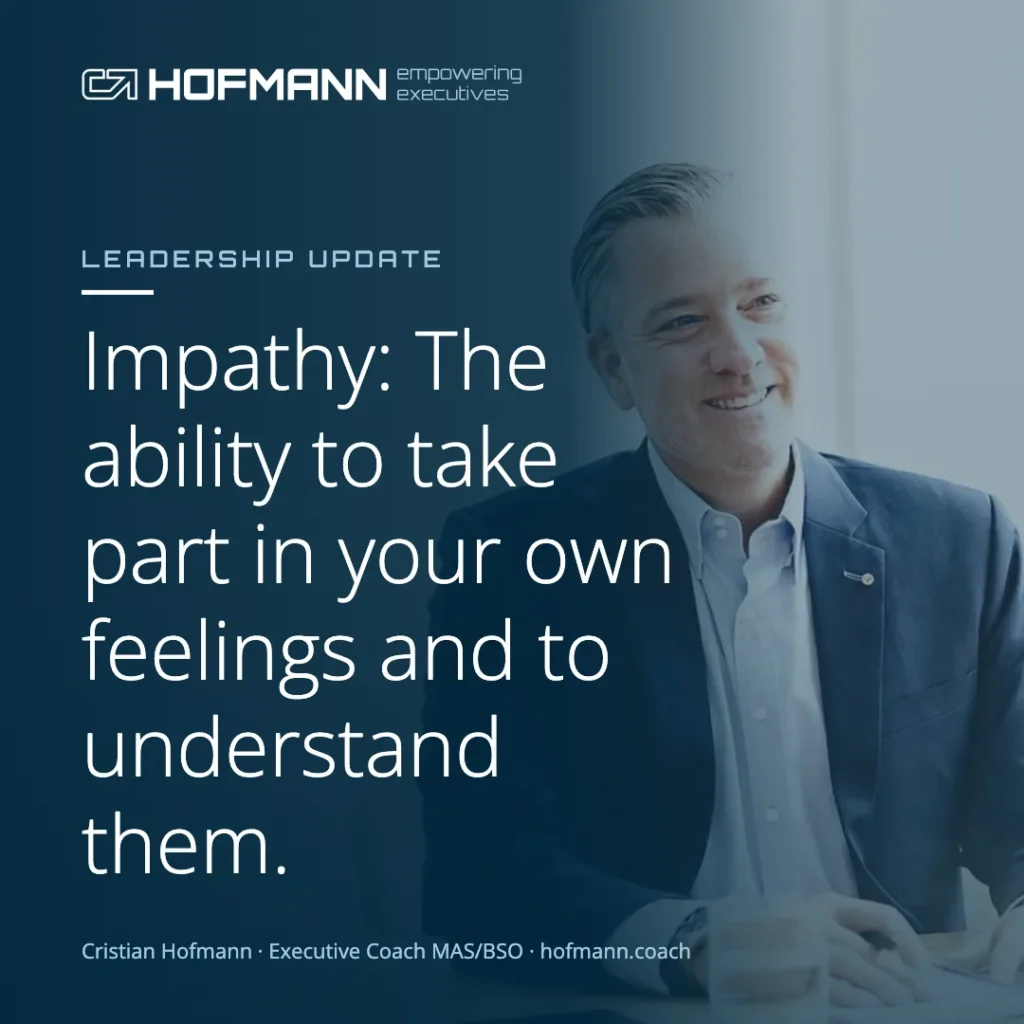
In leadership, empathy has been regarded as a key skill for years. Impathy is the younger term beside it. It describes how we process our own experiences before we turn to others. I wrote about the concept for Forbes in 2023. Here is the full version, extended by what I have seen since in executive coaching.
As an executive coach I keep up with research in psychology. With my background in hypnosystemic coaching, I was especially intrigued by Stefanie Neubrand's work on impathy (Frontiers in Psychology, 2022). Impathy, understood as the non-judgemental acceptance of our internal experiences, has a measurable effect on leadership effectiveness and personal growth.
Impathy is an intrapsychic process. It stays neutral regarding the content of an experience and focuses on how we process that experience. By adopting an accepting attitude toward our own thoughts and emotions, we reduce internal criticism and judgement. This leads to better internal alignment: The better we understand our feelings and needs, the more coherent our actions and decisions become.
Research indicates that self-criticism is associated with depression (Zhang and Watson, 2017), making impathy an essential aspect of mental well-being. Acceptance-based therapeutic approaches teach people to perceive thoughts and emotions without evaluating them or being carried away. The ability to accept oneself is considered vital for overall well-being and usually requires a healthy distance from personal experience.
Impathy also involves perceiving our own phenomena without being overwhelmed by them: A balance between proximity and distance that preserves autonomy and flexibility, even in unfriendly encounters.
A central component of executive function is the ability to choose how we relate to ourselves. Part of that is meta-level processing: Shifting attention and focusing deliberately on specific aspects of our experience. This creates an internal space in which we can handle what occupies us intentionally.
It is therefore to be expected that an increase in impathy goes along with improvements in meta-level processing. Together they offer greater psychological flexibility in dealing with experience, which makes them essential for mental health and for any process of change.
Developing impathy facilitates more flexible forms of the intrasubjective relationship, in other words the relationship we have with ourselves. Learning to regulate the distance to our emotional states lets us navigate internal experience more safely. For leadership development and executive coaching this is the core: Most leadership problems I see are, first of all, problems in the leader's relationship with themselves.
Leaders with impathic skills understand their own internal processes better. They meet challenges with more self-awareness and emotional intelligence. By accepting and regulating their own experiences, they create a safe environment in which open communication, trust and employee well-being become possible.
Impathy also allows decisions that are not overlaid by personal bias. A leader who stays with themselves can hold several perspectives at once. That leads to better solutions and to decisions the team carries.
Impathy starts with the conscious perception of our own emotions, needs and challenges. Understanding ourselves better gives direction for authentic solutions.
People who overcome their own obstacles on an impathic path and bring about positive changes in their lives gain confidence in themselves and in their ability to shape their lives authentically.
Those who grow in their relationship with themselves become an example for others. Employees and colleagues see how someone handles their own difficulties and find in it the permission to try it themselves.
Impathy encourages people to engage with their own challenges and contribute to the greater good. Giving team members the concept gives them a tool for positive change in their lives and at work.
Impathy can be practised, in minutes rather than months. The exercise I give leaders most often: Before a difficult meeting, answer three questions. What am I feeling right now? What do I need? Which of that belongs in the meeting, and which does not? The third question is the impathy question. It separates what moves me from what the team needs.
The most common objection is that this is self-absorption. The opposite is true. A leader who knows their own state has capacity for the state of others. One who does not, projects.
Further reading on hofmann.coach: Impathy meaning: The concept in brief · Self-confidence: The most powerful weapon of a leader · Executive Coach
Note: This article was published on 27 June 2023 as «The Power Of Impathy For Leadership Excellence» in the Forbes Coaches Council. Sources: Neubrand, S. (2022), Frontiers in Psychology; Zhang, H. and Watson, N. (2017), Self-Compassion Research. The extension is mine.
Cristian Hofmann is an executive coach in Zurich and Schaffhausen (MAS Coaching & Supervision BSO, Forbes contributor). Over more than 20 years he has coached more than 1,500 leaders: CEOs, executive boards and leadership teams in Switzerland, with measurably agreed goals and, on request, pay-for-results. More about Cristian Hofmann.